I have a Solution that will reduce pressure on IIT aspirants but do not know how to get this across to HRD Minister of India. Suggestions are welcome. - Ram Krishnaswamy

Search This Blog

Wednesday, February 28, 2018

Jharkhand girl flings herself before speeding trucks thrice, saved each time; suicide note tells of family pressure to crack IIT test - New Indian Express


By Anand ST Das  |  Express News Service  |   Published: 25th February 2018 08:57 PM  |  
Last Updated: 25th February 2018 08:57 PM  |   A+A A-   |  


Image used for representational purpose.
PATNA: A 17-year-old girl made three attempts to kill herself by flinging herself before speeding trucks on a highway in Ranchi, but was saved each time. A suicide note recovered from her revealed she was fed up with her father’s insistence that she clear the IIT entrance test even though it was too hard for her to remember her lessons.
“I love you all very much. This is not a road accident. This is a suicide,” wrote the girl at the end of her suicide note written in Hindi. “Papa, you sometimes ask me to clear IIT entrance test and sometimes to secure 75 per cent marks (in intermediate examinations). I cannot do anything due to the tension,” said the letter she addressed to her parents and two brother.
Police said the girl was seen running across the ring road in Sithio area of the Jharkhand capital on Friday night, making several speeding heavy vehicles dodge her riskily. Bystanders were shocked by her behaviour when she kept standing on the busy road even after a speeding truck swerved dangerously to avoid hitting her. Some of them caught hold of her during her third failed bid to kill herself by running in front of a truck.
Rashmi (name changed to protect identity) is the only daughter of an official working with the road construction department of Jharkhand government in Dhanbad, said police. The people who saved her found her clutching a suicide note and brought her to Tupudana police station. Her family, which lives in Ranchi’s Hinoo area, was informed and she was handed over to them.
“I am unable to study. I have tried very hard, but I have failed. Whatever I memorise I forget the next day… I have also forgotten all that I had memorised earlier,” she wrote at the beginning of her suicide note.


In a glimpse of the tensions prevailing in the family, she wrote at one place: “Both my brothers do drama in the house every day. Nobody ever takes my side. Everyone keeps blaming me. Papa, I am not wrong all the time. Please sometimes accept my side of the story. You always get angry with me”.

“This case is just a pointer of the massive psychological crisis today’s teenagers face due to overwhelming family pressure for academic excellence and the endless thrills offered by the world in many intrusive forms,” said Patna-based clinical psychologist Binda Singh. “Attaining the right balance in life and having an atmosphere conducive for proper learning are extremely important for youngsters,” she added.

Monday, February 26, 2018

Youngest citizens cry out for attention - Telegrapg India

Suicide bid over exam
Vijay Deo Jha Feb 25, 2018 00:00 IST


ANGUISH: The suicide note of the Ranchi teen (her face pixelated for privacy) who was saved on Friday. Telegraph picture


Ranchi: A teenage girl, trying to jump before speeding trucks on ring road in Sithio here late on Friday night, was saved by alert patrolling party of a private road construction company.
Daughter of a bureaucrat, the Plus Two student's suicide note in Hindi mentioned high academic expectations of her father as the main reason for her wanting to kill herself. Her father wanted her to crack IIT entrance and score highly in boards even as she was forgetting her lessons due to tension, the note categorically says.

The girl, who lives in Hinoo, was spotted by the site patrolling party of one Elsamex Maintenance Service, hired by Jharkhand Accelerated Road Development Company Limited, which looks after maintenance of ring road.

Associate manager of Elsamex Maintenance Service, Satyaranjan Rao told this paper that around 10.30pm, their staffers informed him that they had caught a girl with a suicide note in her hand.

"My staff was patrolling in the locality to ensure the safety of our construction materials and equipment. They saw a girl abruptly running on the middle of the road recklessly despite speeding trucks. She could have been mowed down by any truck. A truck almost hit her but the driver swerved aside. But the girl remained standing on the road waiting to be killed. That's when my patrol members dragged her to the side of the road," Rao said.

Reportedly, then the girl broke down and cried out that she did not want to live anymore.

Seeing the suicide note, the patrol party immediately informed Tupudana police, under whose jurisdiction the area falls. A PCR team took her to Doranda police station and her family was informed around midnight.

The letter clearly reveals the girl's tremendous mental pressure to clear the IIT entrance and score well in her exams. It was also clear from the letter that she shared a tense relationship with her two brothers and she said she was being misunderstood by her father.

"Papa, I am not always wrong, you always scold me. Sometimes listen to me also. Since nobody trusts me I think my life has no meaning", the letter said, but ended by saying she loved them all.

Contacted on Saturday, her father, a road construction department employee in Dhanbad, pleaded for privacy. "As a father I am shocked. I request the media to respect her privacy in her interest," he said.

Police also refused to give the girl's details. "It's a sensitive matter. The good thing is that a young life is safe. The girl is at home," Hatia DSP Vikas Kumar Pandey said.


Wednesday, February 14, 2018

‘Many institutions under threat, young leaders a hope’ By TOI | Tuesday | 13th February, 2018 LUCKNOW: The nation is under a severe threat, with its prestigious institutions facing damages and destruction at the hands of communal forces under the regime of Prime Minister Narendra Modi , said social activist and journalist P. Sainath on Monday. He said that 3.10 lakh farmers committed suicide in the last 20 years, and if the fixing of MSP at 1.5 times production cost is not increased, it would further dupe farmers as the formula for fixing MSP was grossly erroneous. Sainath said that undeserving people have been posted on key positions in prestigious institutions including FTII, IITs, IIMs, BHU and other universities causing immense harm but added that the young leaders from JNU, Hyderabad and Gujarat are putting up a challenge.Speaking on the farm crisis in nation and recent budget, Sainath said that the government’s policies would not double farm income, but certainly double the suicides by farmers. He was delivering a keynote address at the Mishra memorial lecture organised by NCP state president Ramesh Dixit and his activist ys that only 1% of the population has grabbed 52% wealth in the country.He said that despite his campaigns against mindless exploitation of water by the wealthy in Maharashtra, fancy gold clubs, exclusive and individual swimming pools were going on unchecked while the poor and tribals in Marathwada face water crisis and are forced to buy water. LUCKNOW: The nation is under a severe threat, with its prestigious institutions facing damages and destruction at the hands of communal forces under the regime of Prime Minister Narendra Modi , said social activist and journalist P. Sainath on Monday. He was delivering a keynote address at the Mishra memorial lecture organised by NCP state president Ramesh Dixit and his activist ys that only 1% of the population has grabbed 52% wealth in the country.He said that despite his campaigns against mindless exploitation of water by the wealthy in Maharashtra, fancy gold clubs, exclusive and individual swimming pools were going on unchecked while the poor and tribals in Marathwada face water crisis and are forced to buy water. Sainath said that undeserving people have been posted on key positions in prestigious institutions including FTII, IITs, IIMs, BHU and other universities causing immense harm but added that the young leaders from JNU, Hyderabad and Gujarat are putting up a challenge.Speaking on the farm crisis in nation and recent budget, Sainath said that the government’s policies would not double farm income, but certainly double the suicides by farmers. He said that 3.10 lakh farmers committed suicide in the last 20 years, and if the fixing of MSP at 1.5 times production cost is not increased, it would further dupe farmers as the formula for fixing MSP was grossly erroneous.. - TOI

‘Many institutions under threat, young leaders a hope’
  • By TOI
  •  
  • | Tuesday | 13th February, 2018


Sainath on Monday.


He was delivering a keynote address at the Mishra memorial lecture organised by NCP state president Ramesh Dixit and his activist ys that only 1% of the population has grabbed 52% wealth in the country.He said that despite his campaigns against mindless exploitation of water by the wealthy in Maharashtra, fancy gold clubs, exclusive and individual swimming pools were going on unchecked while the poor and tribals in Marathwada face water crisis and are forced to buy water.
Sainath said that undeserving people have been posted on key positions in prestigious institutions including FTII, IITs, IIMs, BHU and other universities causing immense harm but added that the young leaders from JNU, Hyderabad and Gujarat are putting up a challenge.Speaking on the farm crisis in nation and recent budget, Sainath said that the government’s policies would not double farm income, but certainly double the suicides by farmers.

He said that 3.10 lakh farmers committed suicide in the last 20 years, and if the fixing of MSP at 1.5 times production cost is not increased, it would further dupe farmers as the formula for fixing MSP was grossly erroneous..

Wednesday, January 31, 2018

IITs resist Centre move to link funds to performance - New Indian Express

By Sumi Sukanya dutta  |  Express News Service  |   Published: 30th January 2018 02:11 AM  |  

                             IIT-Kanpur (File | PTI)

NEW DELHI:The IITs are resisting a government move that proposes to impose an agreement with the Union HRD Ministry in order to give them grants, from this year.

A draft proposal has been sent out to all 23 IITs — which receive about Rs 5,000 crore annually from the HRD Ministry cumulatively — seeking their suggestion. The seven older IITs get about `500 crore each annually.

“The plan is to link the funds with the action plans and performance ratings  in order to make them more accountable and urge them to raise their revenues by increasing student intake, number of courses and research engagements,” a senior official in the higher education department of the ministry said.
One of the clauses includes asking IITs to pay 30 per cent of teachers’ revised salaries from own resources. 

There would be separate performance rating only for IITs that will rate them positively or negatively on indicators such as student-teacher ratio, placement percentage, filing of annual reports on time, vigilance or CBI enquiries and suicides by students.

Indore: PhD scholar warns HRD minister Prakash Javdekar… - Free Press Jopurnal

— By Staff Reporter | Jan 30, 2018 10:04 am

Another Vemula in the making at IIT Indore

Indore: A netizen claiming to be a research scholar of Indian Institute of Technology (IIT) Indore tweeted that the institute has toughened situation for PhD students so much so that another incident like the tragic suicide of Rohit Vemula could take place any time on the IIT campus.

“IIT Indore is changing rules every year for PhD,” the netizen claimed uploading a schedule in which number of publications fixed for a PhD scholar has been mentioned.

As per the schedule, in the year 2015 each PhD scholar was required to publish/present two papers either in journal or conference in four years. The schedule further reads that the number of journals was increased to three in year 2016/17 but the duration was also increased from four to five.

In 2018, the number of journals has been increased to four with duration of only four years.

In a tweet to HRD minister Prakash Javdekar, the netizen said: “I think your ministry is waiting for some mishappening like Rohit Vemula type of event to take place at IIT Indore campus. Please don’t use students’ health and life for your vote bank sir. Please look into this matter as soon as possible. Otherwise, the so-called senate new rules can force research scholars turn to be Rohit Vemula of IIT Indroe. #saveiitindore”


I think your ministry is waiting for some mishappening like Rohit Vemula type of event to take place at IIT Indore campus. Please don’t use students’ health and life for your vote bank sir. Please look into this matter as soon as possible. Otherwise, the so-called senate new rules can force research scholars turn to be Rohit Vemula of IIT Indore. #saveiitindore 

–TWEET BY PHD SCHOLAR TO HRD MINISTER

Haunted college campus: Stories of IIT Roorkee and 9 other Indian colleges and hostels will give you goosebumps - Catch news

| Updated on: 30 January 2018, 15:39 IST


Are you a ghost believer? If yes, then this might excite you! It is a strange fact that almost every college and school have a haunted story attached with it. On one hand where some universities are built on ancient burial sites, there are others who have some stories or scenes of suicides or sudden deaths related to it that are supposed to be eerie.

The question that arise here is that is there any university that will claim to be the most spookiest in the land. Since, we were dying to find out the most haunted colleges and campuses in our country, we got our hands on the haunted stories of these famous colleges that will surely give you goosebumps.

Disclaimer: These stories are listings that are based on various reports and stories present on various social media platforms. They may or may not be true and the authenticity of the reports as well as the stories is not guaranteed.

1. MADRAS CHRISTIAN COLLEGE


It has been reported that on several occasions people have heard sounds coming from the empty chemistry labs. They have heard sounds of professors giving instructions related to practicals. Pretty scary!

2. WOMEN’S COLLEGE, CALCUTTA


According to many students, the presence of Hastings’ spirit is felt and around New Year’s Eve many have experienced this phenomena. They claim that during that time the erstwhile general’s spirit would rush up the staircase of his residence which lies within the premises of this college.

3. SNDT GIRLS COLLEGE, MUMBAI


Many people share that around 2 am they can hear a female voice reciting multiplication tables which is followed by sounds of slapping and wailing of children, no satisfactory explanation have been found for this.

4. UNIVERSITY OF PUNE


There is a grave of Alice Richman. Alice died due to cholera in 1886. However, many believe that this is not the reason for her demise and she either committed suicide or was killed. People have claimed that they have seen Alice Richman's spirit wearing a white gown, walking around in the campus.

5. IIT, ROORKEE


A student committed suicide by hanging himself from the ceiling fan in his hostel room. This incident took place a couple of years ago and after that rumors started spreading that the place is being haunted by the spirit of this student.

6. ST BEDE’S COLLEGE, SHIMLA


Many girls of this college have shared that they often hear mysterious sounds from the dining room close to midnight. The faculty of this college says that since the college is situated on the hills there is often sound of wind or the rustling of leaves which sounds creepy at night.

7. KASTOORBHA MEDICAL COLLEGE, MANIPAL


The stairways of the Kastoorbha Medical College is said to be haunted by an unseen person who claims to be trapped in the 8th floor, though the college building doesn’t have an 8th floor.

8. AGRICULTURAL UNIVERSITY, ALLAHABAD

The girl’s hostel in this campus is said to be haunted. The nature of the ghost remains questionable as there is no common story of haunting experience and the story differs from person to person.

9. RAMNARAIN RUIA COLLEGE, MUMBAI

A spirit wanders the corridors of this college and this story is quite popular. It is said that in class room no S26, you can sometimes hear and see this paranormal entity. The mini-auditorium of the college and also the ladies common room are also said to be sites of paranormal activities.

10. SINHGAD ENGINEERING COLLEGE


At night, spirit of one of the engineering students, who had committed suicide in the college, after he failed in his exams, is said to be wandering around the premises of college.


Horlicks talks about IIT, exam phobia and suicides in viral digital campaign - Live Mint


Horlicks new digital campaign titled ‘Fearless Kota’ highlights the innumerable pressures that students go through to crack the IIT exams
Last Published: Tue, Jan 30 2018. 12 52 PM IST

A screenshot from the ad campaign. Horlicks ad has brought to the fore crucial mental health issues and the mounting examination pressure which often leads to fear of failure, stress, depression and suicides among students.

New Delhi: In India, no success is sweeter than landing a seat in a prestigious educational institution like an Indian Institute of Technology (IIT), so much so that parents send their children for coaching to places like Kota.

Horlicks, the malt-based health drink by GSK Consumer Healthcare, chooses to highlight the innumerable pressures that students go through to crack the country’s toughest competitive exams for engineering and medical in a new digital campaign.

The film, made by advertising agency FCB Ulka, is set in Rajasthan’s city of Kota, the country’s biggest hub of coaching centres for entrance examinations, and traces the obsession with securing a high rank in these exams which often leads to insurmountable pressure on students. Aptly titled Fearless Kota, the ad is divided in two halves. While the first half familiarizes viewers with statistics on the alarming number of suicides among students, the other half talks about the value of emotional support and shows mothers of students coaching in Kota paying a surprise visit to encourage them to tide over the tough time.

Clearly, the ad has brought to the fore crucial mental health issues and the mounting examination pressure which often leads to fear of failure, stress, depression and suicides among students.

“Through the Fearless Kota film, we wanted to highlight that along with a healthy body, a healthy mind is equally important to perform. Therefore, the right emotional nutrition is needed for children to overcome the fear of exams. The film captures the belief that a mother’s love is the best dose of emotional nutrition that helps a child overcome stress and face exams fearlessly,” said Vikram Bahl, area marketing lead, nutrition and digestive health, GSK Consumer Healthcare India.

The emotional execution of the video has resonated well with viewers online with the film garnering over 10 million views on the brand’s YouTube channel and over 2.3 million views on Facebook.

“Students in Kota have access to the best faculty and world class facilities, but they’re missing a fundamental need that is as biological as the need for vitamins. We’ve termed this emotional nutrition, and Fearless Kota is our way of showing its power. Going forward we will build on this narrative,” said Swati Bhattacharya, chief creative officer, FCB Ulka.

Horlicks ad follows a similar narrative of what PepsiCo-owned Mirinda did in its Release the Pressure campaign last year where it talked about exam pressure. Tata Tea also did an ad talking about exam stress which often leads to depression and suicidal tendencies among teenagers.

Meanwhile, Horlicks’s competitor Bournvita also created a campaign Tayyari Har Exam Ki, which featured a school principal explaining to parents why good grades are not an insurance to success in life.

Ayan Banik, head–brand strategy, Cheil India, gave full points to the execution and brand fit to the Horlicks ad. However, he noted that the film leaves one wanting for more. He said that although the Mirinda campaign had a weaker product connect, it was an activation where students write open letters to their parents about exam stress which made it look more convincing.

“Any on-ground activation idea with a strong social engagement currency is way more powerful, endearing and real than a piece of ‘nice advertisement’. So in that sense the Horlicks ad comes across as a ‘me too’ piece of communication, without a fresh perspective,” he said.

Banik feels Horlicks could have offered more tangible solutions to students. “For instance, it could be in the form of a 24x7 Horlicks helpline number manned by psychiatrists who could actually come to the rescue of these students. I feel it may have been way more effective than a visit from mothers with home cooked food,” he added.

Athul Chathukutty, creative director - copy at advertising agency Happy mcgarrybowen, who also happens to be an engineer feels that the concept of “Emotional Nutrition” is fascinating. It also has an instant connection with the Horlicks brand.

“However, by simply bringing mums to visit their kids doesn’t seem like a very feasible solution and actually weakens the solid premise. Also, it also typecasts dads as the bad guys, which isn’t always the case,” he said.

Chathukutty is hopeful that the brand will do something more long-term towards this issue. “I must add that it is quite admirable that the cup of Horlicks appears only fleetingly in the ad; makes me want to trust Horlicks’ noble intentions,” he said.


First Published: Tue, Jan 30 2018. 12 21 PM IST

Tuesday, January 30, 2018

Ex-Kota IITian recalls the pain - TNN


Anahita Mukherji | TNN | Jan 3, 2016, 00:00 IST

Dhruv Arora recently revisited Kota, the dusty town where he had spent two of the most painful years of his life a decade ago, preparing for IIT. 

Arora, an alumnus of IIT-Bombay, feels Kota has become progressively worse, with coaching factories growing in size - what was once a three-storey building with 5,000 students has turned into a 10-storey building with 30,000 students. 

Back in his student days at Kota, he, too, would ask himself if the life he lived there was "normal." Even though the town drew a diverse mix of students from across India, there was virtually no cultural exchange between them. There were no entertainment options or extra-curricular activities either.

"It was so competitive that if you missed a class and asked fellow students what the class was about, they'd dismiss it as unimportant and not tell you the content of the lecture," says Arora, adding that there was less competition on the IIT-Bombay campus than there was in Kota. 

TOP COMMENT
If IITIANS are so smart, shouldn't they develop a smarter way of selection?
One that is more holistic, not dependent on the performance of the person in those few hours of his life but overall, and one that Kota like factories cannot build empires on?
Pallavi

He says he was lucky because his family in Mumbai did not pressure him to make it to IIT. "My parents are liberal and well-travelled. They constantly reminded me that it was only an entrance exam," says Arora. In fact, he says that had he not made it, there were many other things he could have done in life. He would certainly not have stayed back in Kota and repeated the JEE attempt. "When I was studying in Kota, nearly 30-40% of students there were repeat candidates," says Arora.

He points to the immense family pressure many face to get into the IITs. "This is especially true for boys and girls from smaller towns, who have seen the extent to which an IIT degree can change the course of a person's life. When an older sibling has made it to IIT, they want the younger sibling to make it there, too," he says.


He doesn't blame Kota alone for student suicides. He blames the general environment in India, where a few institutions are put on a pedestal.

Why Kota is so killing - TNN


Akhilesh Singh | TNN | Updated: Jan 3, 2016, 02:14 IST


18-hour study schedules. A brutal sorting system that segregates 'average' students. No fee refund policies for those who want out 

'We can't take it anymore. Our parents have told us to return home only after cracking IIT-JEE," said two distressed young students to psychologist Dr ML Agarwal in Jawaharnagar, Kota. The boys were both from Bhatinda, Punjab, where they lived in large joint families. They found themselves unable to cope in their new environment, with daily tutorial classes, and having to study for up to 18 hours a day. "It took months of therapy at a rehabilitation centre, and the involvement of their families, to restore them," says Dr Agarwal.


These breakdowns are all too common, across a city that reinvented itself in the late '90s as coaching hub for the hyper-competitive engineering and medical school exams. Roughly 1.6 lakh teenagers from the surrounding states flock to Kota's coaching institutes every year, paying between 50,000 and a lakh for annual tuition. Some begin early, as coaching centres also run ghost schools where they enroll middle-school students. In a few institutes, they are taught by IIT alumni, who claim salaries of Rs 1.5-2 crore for their expertise. Neither coaching centres nor hostels have exit policies or refunds, so for students who borrow money to come to Kota, the stakes are even higher.

Most students live in rented rooms with minimal facilities. They may desperately dream of IIT, but many of them are unprepared for the psychological costs. Kota has now become a byword for student suicides. A 14-year-old boy killed himself recently, the 30th suicide last year. Purushottam Singh, whose nephew Shivdutt committed suicide on December 22, is in tears as he talks of the boy. Back home in Kollari village, Dholpur, Singh says, "there were high expectations of him. His family and neighbours had already started calling him doctor sahib." The parents of 17-year-old Suresh Mishra (name changed), from Vidisha, now regret having sent him to Kota. "It started with headache, fatigue and bed-wetting. He now suffers from blackouts, partial memory loss and occasional hallucinations," says his father Mukund.

Around the world, student burnout is caused by high rates of physical and emotional exhaustion, a sense of being depersonalised, and a shrunken sense of personal achievement. Kota is a cauldron for all these feelings, with other factors like the fear of letting down one's family, or not having any career alternatives.


All around Kota, the message is to excel, or be left behind. Billboards celebrate success and star students. Entry into IITs or the other engineering and medical schools is seen as the only measure of worth. Coaching institutes, though, admit anyone who can pay the fee. Then begins the brutal sorting of students into different batches on the basis of their performance. Those who lag in their studies live in terror of these internal assessments, and struggle with their sense of inadequacy. Some are doubly challenged, with the Class XII board and the competitive exams.


The problem, though, is that while Kota's coaching centres can find and hone smart students into the perfect JEE test-takers, they are thrown by "weakness" in students. Their performance criteria does not factor in vulnerability or burnout at all, making it hard for students to seek help. As Naveen Maheshwari, the director of Kota's largest coaching institute puts it, "average performers are bound to fail" in this competitive place. "In such an environment, parents should understand that IITs and AIIMS are not the end of the world. They should stop imposing their own dreams on children."

TOP COMMENT
All of these coaching centers transform the students into machines...kill the joy of thinking..curtail creativity...i quit a gate coaching institute half way cuz of the methods they use...its better to enjoy the concepts rather to store and vomit them just to get a seat into iit..

HEADSHOT Olympus

And yet, the idea that coaching centres have a responsibility for the mental wellbeing of students in their tutelage is only now dawning on them. Maheshwari now plans to institute random silent psychometric tests to detect vulnerable students who can be kept under watch. However, he claims that students get even more depressed if their parents take them back home.

Meanwhile, jolted by the serial suicides, the district administration is also awakening to its responsibility. Kota collector Ravi Kumar, says, "We have taken some steps, like an advisory to coaching institutes to screen students for aptitude. We are setting up a helpline to counsel students."


Drugs, sex, stress: Why Kota may be a bad place for your child - TNN


Hemali Chhapia | TNN | Updated: Jan 28, 2018, 08:02 IST

HIGHLIGHTS
  • Between 2013 and May 2017, 58 student suicides were reported at coaching centres in Kota.
  • The police records, however, give no information on attempted suicides.
  • Every year, approximately 1.5 to 2 lakh students come to Kota to realise their dream of getting into an engineering or medical college.
MUMBAI: Self-harm, substance abuse, bullying, sexual experimentation and the possibility of pregnancy, sleep-related issues, loneliness, weight loss, acidity and anxiety are common among students in Kota, the coaching class capital of Rajasthan famous for offering preparatory courses to IIT hopefuls, a report by the Tata Institute of Social Sciences has said.


The report, submitted recently to the Kota district administration which had commissioned a study to find out reasons for student suicides, has a crucial suggestion for parents who aspire to send their children there: "Do an initial recce, if possible, to understand the atmosphere of Kota, to decide if it is right for your children. Kota is not the best place for all children; some find it difficult to adjust to living away from home." 

The study has also suggested ways to ease academic stress. Class sizes in coaching academies could be cut to a fifth. Advertisements on exam results could reveal the truth instead of throwing up fantastic numbers. Recreational activities such as music and dance could be woven into the rigorous competitive exam preparation timetable, and batches may no longer be segregated based on academic performance. 


Between 2013 and May 2017, 58 student suicides were reported at coaching centres in the district, show police records, which however give no information on attempted suicides. In fact, between 2011 and 2014, suicides in Kota due to failure in exams made up the highest percentage of such deaths among 88 Indian cities considered for the study. 

Every year, approximately 1.5 lakh to two lakh students come to Kota to realise their dream of getting into an engineering or medical college. Who are these students — mostly boys and a few girls? What is a day like for them? What do they eat? What academic pressure do they face? How does Kota treat them? 

The researchers — dean of the TISS school of human ecology, Sujata Sriram, assistant professor Chetna Duggal, counsellor Nikhar Ranawat and counselling psychologist Rajshree Faria — looked into all these questions, with the respondents giving replies on a "perceived stress scale" framed for the survey. 

"Forty-nine per cent of respondents cited feeling nervous, worried and scared; 42% mentioned that their friends were nervous, scared and worried. Thirty-seven per cent said they felt easily annoyed or irritable, followed by 32% who said they were upset or sad for most part of the day or for many days at a time," stated the report. 


"Feelings of hopelessness and helplessness were expressed by 28% respondents; another 28% expressed feelings of worthlessness. Serious concerns of feeling like a failure and letting down the family were expressed by 27% of the respondents." 

Many students reported sleep-related problems, of not being able to wake up or falling asleep or staying asleep. Problems of constantly feeling tired were mentioned, as were those related to eating and food and loss of appetite and weight. While digestion trouble figured on the list of issues, around a third of the female students spoke of problems with their menstrual period, the report stated. 


The researchers noted that very often, messes bought the lowest quality of vegetables — leftover stock or stock not considered suitable for sale due to the price factor. "This kind of stock was colloquially referred to as "mess-quality" vegetables. Students had repeated concerns regarding the quality of the food served (uncooked rice, watery dal and stale food), lack of healthy food available in canteens, hostels and messes, lack of hygiene in kitchens, hostels providing good-quality food only in the beginning of the session and differing palates."

Similarly, hoardings that welcomed many to Kota made "inflated claims". While each coaching centre advertises the names, rank and photographs of successful candidates, the actual percentage of success was not disclosed to TISS researchers. 

TOP COMMENT
Children are going through the same stress everywhere. It''s the result of handful of jobs vs humongous population. Jobs will never catch up with our growing population that''s a fact. It''s all about survival of the fittest now.
Selene Nixon

The report recommended that there should be accurate display and communication of the coaching centres' success rates in IIT-JEE, NEET, and other entrance exams. Again, any form of advertisements by coaching centres should incorporate a disclaimer stating that studying in that particular coaching centre does not guarantee admission into medical and engineering colleges, it said.

Other proposals include reduction of the class population of 200 to 40 each, appointment of trained counsellors and clinical psychologists, sensitisation of teachers on mental health issues, availability of on-call doctors, creation of a recreational room for games, screening of movies, formation of peer mentor groups and removal of pigs and stray cattle.


Wednesday, January 24, 2018

On the Menace of Reservation(s) and Quota(s) - Kashmir Reader

By reader on January 23, 2018No Comment

JAVEID HASSAN MALIK

I vividly remember the day when my teacher asked me in university, in which category you have been selected in the Master’s degree program. I answered authoritatively that I secured admission in the open merit category. While as, my fair-weather friend, seated beside ducked the same question with a lie by answering that he too was selected in general category even though he belonged to reserved category (RBA) as he felt it as matter of shame and disgrace to disclose his category status before fellow classmates. Time passed by but my class mate always kept his category status hidden under the smokescreen of lies. Today, the same person of mine is working as teacher in school education. What made him reach there was not his intelligence but the blessing of the RBA certificate (resident of backward area) which overshadows a deserving candidate in every competitive exam; thus his shame became his fame.

This is the story of the majority of RBA candidates; they only pop their head up like a hydra when it comes to availing benefits for government services for being backward. Almost 20% of seats are reserved for candidates belonging to backward areas. While my friend got appointed as general line teacher as a simple graduate, many other friends of mine continue to pile degree after degree and are yet to get a government job. I can’t blame their failures to RBA quota but it hurts when you have been elbowed out of race not by someone who is more talented and gifted than you but by someone who is nowhere in the competitive race.

Few days ago, I came across a picture which sums up the whole plight of general category candidates; it the picture depicts three friends belonging to three different categories OM, RBA and SC in a hostel room. The OM candidate is seen busy with his studies, while the RBA candidate is having the fun with his phone with ear phones plugged in while as SC candidate is sound asleep. In the second half partitioned picture tagged with the caption of “after six years”, the SC candidate is seen as a boss on rotating a chair while RBA candidate is working as the personal assistant to his SC friend while as OM candidate is serving tea to both.

Being an RBA is a blessing in disguise for its beneficiaries in the contemporary era of “dog eat dog competition”. Unlike open merit candidates , who have to move from pillar to post to avail government job and have to create something out of nothing for their survival, the RBA candidates have it made. The RBA should have been a one-time benefit but its beneficiaries continue to enjoy the fruits of category certificate from womb to tomb, from class 12th onwards when they appear in JKCET exams to getting admission’s in other professional courses; thus many candidates who are not fit for the course end up getting it in gift courtesy of reservation and often these candidates don’t fit in demanding circumstances thereby blocking the way of genuine and deserving candidates. It is grotesque when a candidate with 60 points fails to figure in the Assistant Professor selection list while as the candidate who scored only 46 points is serving as an Assistant Professor just because he was a category candidate. 

A few years ago, the administration was concerned about rising suicide rates in IITS. When the government investigated the matter, they came to the conclusion that most of the candidates who committed suicide belonged to SC/ST categories. They were unable to cope with course syllabii; so they unfortunately ended their lives in frustration.

From a broader perspective I am unable to come to grips with what it takes to constitute a backward area. If it is an isolated village without facility of macadamized roads, no electricity, no water supply, no telecom connections then I hold no doubt in stating that there is no village in the valley which qualifies to be backward. The sad fact is that when the west is planning to settle life on mars, in this region, the fighting and the debate is on reserved categories. Politicians here are doing what amounts to putting the cart before the horse just for the lure and lust of power. The perverse irony is that instead of abolishing existing RBA villages which no longer fit in the backward status as enough of development work has been done in these areas they are promising to register new villages in RBA to gain votes from gullible villagers.

Why is the administration here turning a blind eye towards this monster of reservation which is snatching the rights of genuine and deserving people? In the 21st century, where technology has enveloped the whole world into global village, no one should demand reservation as technology never discriminates. Time has come for powers that be, if they really care about people, to revoke this very discriminating. One first step would be to declassify the villages with a legacy of RBA which they no longer deserve. Otherwise if, in the future, the government sends manned space craft to moon, they have to kept seats reserved for reserved categories while as astronauts will have to give it up before reserved quota!

—The author holds a Master’s in Chemistry. He is also NET/SLET qualified and can be reached at: malikjavid86@gmail.com

January 24, 2018 at 8:05 am

Your comment is awaiting moderation.

I am an IIT Alumnus maintain the Blog on Suicides in IITs as for decades suicides were being swept under the carpet by IIT administrators. https://iitsuicides.blogspot.com.au/ and the above article resonates and echoes my thoughts and feelings on Reservation in IITs. Yes I agree the down Trodden need a Hand to pull them out of their misery but you don’t feed the man fish but teach him how to fish to survive.

I am neither a Brahmin – Mind you they are not all elite and intelligent plus there are some extremely poor Brahmins in India who need help too. I do not belong to the SC/ST Class either. I am the son of a Central Govt Servant in Port Blair Andamans, not very well off yet my parents made sure I along with my six sisters got the best education. He told us I do not have any wealth to share with you all but I am giving you the best wealth of Knowledge and education, that will help you stand on your own legs and feet. All of us even through we are Hindus studied at Catholic schools. Each one of us excelled at school and most of us had our tuition fees waived by the schools. I was a class topper from 6th Std to 10th Std. in 1963 I did not know anything about IITs but a good friend insisted I submit an application for the Entrance Exam ( without my fathers knowledge) and I am proud to say that with nil preparation plus seeing a movie at the Cinemas the night before I made it into IITMadras. My father put his foot down and said no IIT Bit CIT you are going to Guindy College. Some how good sense prevailed and my Dad agreed to let me stay in the hostel and pay my mess bills which he could not afford. At IITM I went down the slippery slide from Ducks at School to become the Dunce of the class.. Every chap in my class was a rank holder in his school. Plus Madras Uni PUC curriculum did not include Calculus as compared to chaps from up north like Delhi Madrasi schools and the Central Board schools. This was a huge set back plus faculty did not care about individual students. They just came taught and left and we were all mere numbers. At the end of my 2nd year I told My Dad, I think I am going to fail in maths Dad. He said what ? Maths that is your favourite subject… Not any more I said it is my night mare now. Now if this was my experience at IITM coming from an English medium Catholic school in Madras, imagine a poor kid from SC/ST background from the village who did not speak or write English and here he was listening to lectures in English and surrounded by kids from rich urban families with Nikes and Apple Macs and Smart phones and there you are with just a few shirts and pants and wear chappals and have a small note book and a ball point pen at your disposal. The worst thing is that no one wants to know you on campus. You virtually don’t exist as every one looks past you. Your own classmates avoid sitting near you ( not because you are an untouchable, but because you do not deserve to be in IIT) and in the hostel mess you are on your own in one corner…Can this kid survive in an IIT ? No Way.. I remember cursing the HRD Minister Arjun Singh for interfering with IITs which are supposed to be autonomous bodies and introducing Reservations that has not served any purpose besides driving these Quota students into depression and suicide for no fault of theirs.
If HRD wanted to really help the down trodden BPL student population they should identify kids with potential as early as 6th Standard with a basic exam in maths and language and create special schools for the talented, irrespective of caste and creed. The only criteria has to be families financial status. But then no govt is interested in such ideas unless it will get them votes at the next elections. Perhaps the Current Modi Govt should reconsider the effects of Reservation in higher education as it is not serving the very people it is supposed to.

Ram Krishnaswamy
Sydney Australia

Tuesday, January 23, 2018

Anti-suicide measures should be implemented swiftly and strictly - Hindustan Times


One big drawback in India’s fight against suicides is the inadequate mental health infrastructure in the country. The country has only 0.301 psychiatrists for every 100,000 people suffering from mental illnesses.

EDITORIALS Updated: Jan 21, 2018 19:54 Ist
Hindustan Times

One big drawback in India’s fight against suicides is the inadequate mental health infrastructure in the country. The country has only 0.301 psychiatrists for every 100,000 people suffering from mental illnesses(Getty Images)

Last year, five students committed suicide at the Indian Institute of Technology, Kharagpur, one of the most prestigious engineering colleges in the country. Although the rigours of academics and the pressure to succeed are higher in engineering colleges, they are not the only ones facing the brunt of student suicides. Between 2011 and 2016, 49,249 students in India killed themselves. Statistics from the National Crime Records Bureau show that 6,654 students committed suicide in 2012; 8,423 in 2013; 8,068 in 2014; and 8,934 in 2015. The number went up to 9,474 in 2016, says NCRB data shared by the ministry of home affairs in Parliament last month.
Concerned over the spate of suicides in our colleges, the ministry of human resource development has circulated a manual to the country’s higher education institutions, asking the authorities to adopt measures to prevent students from taking the extreme step. The manual, prepared on the basis of a study conducted across the Indian Institutes of Technology (IITs) by IIT-Kharagpur, lists measures such as early identification of suicidal tendencies, a buddy programme and a double-blind helpline where both the caller and the counsellor are unaware of each other’s identity. Other experts have suggested proactive steps at the adolescent stage itself with the introduction of mental health in school curricula.


Read more
  •  
  • Health department to assess mental health of school children in Rajasthan 

  • A Calmer You, by Sonal Kalra: Make a new connection – with life! 

  • One big drawback in India’s fight against suicides is the inadequate mental health infrastructure in the country. The country has only 0.301 psychiatrists for every 100,000 people suffering from mental illnesses. There were just 3,800 psychiatrists, 898 clinical psychologists, 850 psychiatric social workers and 1,500 psychiatric nurses nationwide, according to a reply from the ministry of health and family welfare in the Lok Sabha in December 2015.

    Given the seriousness and enormity of student suicides in the country, merely sending out an advisory listing preventive measures cannot be enough. The State should ensure that these measures are implemented strictly and not just in government-run colleges. Privately-run institutions and coaching centres, many of them with little or no counselling services, should not be allowed to get away lightly. That is the least the State can do in a country that is likely to become the youngest nation in the world (with an average age of 29), by 2020.

    Monday, January 22, 2018

    19-year-old IIT aspirant hangs self in Kota - TNN


    19-year-old IIT aspirant hangs self in Kota
    TNN | Updated: Jan 21, 2018, 08:42 IST


    Representative image

    KOTA: A 19-year-old IITaspirant from Hajipur in Bihar on Friday evening committed suicide by hanging himself from the ceiling fan of his hostel room in Mahaveer Nagar-I under Jawahar Nagar police station area.

    The body was handed over to the family members who reached here from Bihar on Saturday. An investigation into the matter was initiated after lodging a case under Section 174 of CrPC.

    The deceased Aniket Anand was a Class XII student and was preparing to crack IIT entrance test in a coaching institute of the city, said Neeraj Gupta, circle incharge, Jawahar Nagar police station.

    "After returning from coaching class yesterday noon, he locked himself in his hostel room and did not come out for dinner following which his room gate was broken open,'' he said.

    "If I could score 95% marks.......... If I could lead a happy life like others," reads the notebook page recovered from his room. However, no suicide note was recovered.

    It seems he took the extreme step due to study stress and pressure, Gupta said.

    After post-mortem, the body was handed over to Anand's maternal uncle who reached Kota on Saturday.

    This is the fourth case of suicide by a coaching student in Kota this year since January 1.

    Earlier this month, three other coaching students including two girls, all NEET aspirants, committed suicide in Kota.

    Friday, January 19, 2018

    Students and Dalit organisations across the country led demonstrations in the memory of Rohith Vemula. - News Click

    Newsclick Report 17 Jan 2018

    Image Courtesy: Mubashir Hameed

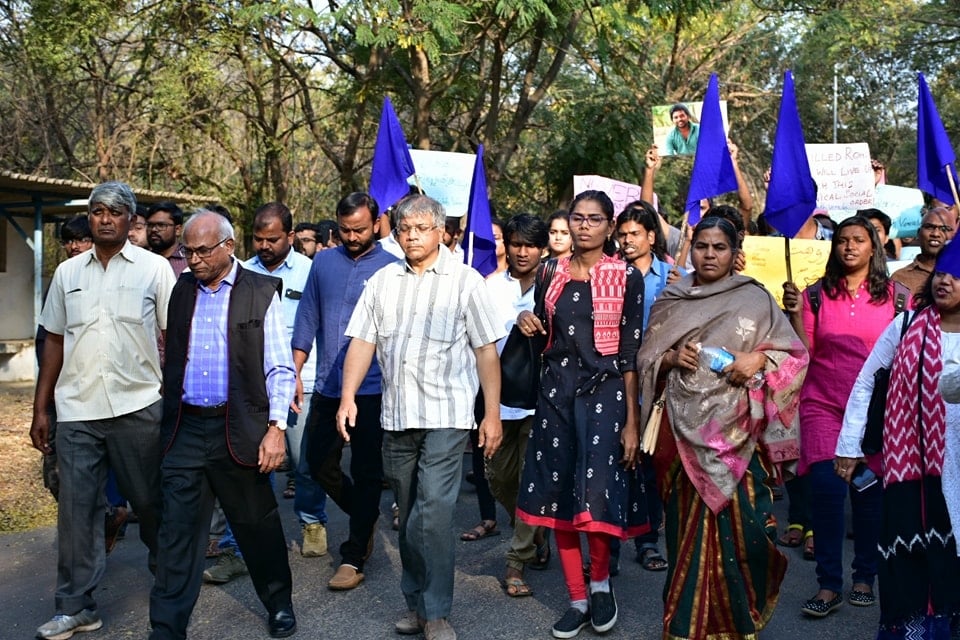
    Two years back on this day, January 17, Dalit research scholar Rohith Vemula committed suicide in NRS hostel in University of Hyderabad. After protesting for two weeks against his suspension along with four other Dalit students, losing hope, Vemula took the extreme step. Outraged over his demise, students of the University led a collective struggle demanding the arrest of University’s Vice-Chancellor P Appa Rao, the then MHRD Minister Smriti Irani, the then Central Minister Dattatreya and ABVP activist Susheel Kumar who were influential for the suspension meted to the five Dalit students. The struggle transformed into a nationwide students and Dalits movement which brought to the forefront, the discourse on the condition of Dalit and marginalised students and the functioning of the Educational system in the country.
    However, when the central government appointed Roopanwala committee claimed that Rohith Vemula is not Dalit as his father belonged to Vaddera caste (OBC) and his Mother belonged to Scheduled Caste- Mala community, no police action was taken against the accused.
    In his suicide letter, Vemula wrote “My birth is my fatal accident…. The value of a man was reduced to his immediate identity and nearest possibility. To a vote. To a number. To a thing.” His letter explained his struggles in his life for being born as a Dalit who eventually became an Ambedkarite student activist.
    Hyderabad University’s Ambedkar Students Association has organised ‘Rohith Shahadath Din’ in Vemula’s memory on his second death anniversary. Students have taken permission from the campus authorities to allow Radhika Vemula along with six others including Kancha Ilaiyah inside the campus and address the students gathering in Savitribhai Phule auditorium. Last year, on the same day, Telangana police had arrested her when she had tried to enter the campus.


    After her son’s demise, Radhika Vemula has been raising her voice against Dalit oppression and has become a part of the Dalit movement in the country.
    Students from Jawaharlal Nehru University, Delhi University, IIT Madras, Osmania University, Tata Institute of Social Sciences and other state and central universities have participated today in demonstrations, rallies to commemorate Vemula’s death anniversary.
    Sunkanna Velpula, one of the five suspended students along with Rohith Vemula wrote on his Facebook wall, “I don’t know whether we have the right to remember you Rohith because we failed to deliver justice for your sacrifice in Hindutva ruling. But one thing is true… We Missed You. There is no one to replace you. You are Unique.”
    Rohith Act:

    Framing and promulgation of a ‘Rohith Act’ which can safeguard the students from marginalised sections in Indian Universities was another main demand from student communities after Vemula’s death. While various political parties, student organisations and social scientists have suggested various drafts for a separate act in Rohith Vemula’s name, however, it has not seen the light of the day in the current BJP-led central government.

    India’s elite IITs have a plan to fix their gender gap—but will it work? - Quartz

    DIG DEEPER

    Still a cause for concern. (AP Photo/Aijaz Rahi)
    SHARE

    "Indian students, teachers and others listen to a speaker during a protest against the arrest of a student union leader of New Delhis Jawaharlal Nehru University, in Bangalore, India, Thursday, Feb. 18, 2016. Scenes of protest that rocked a New Delhi university this week spread across the country Thursday, with students and teachers from cities including Bangalore, Kolkata and Chennai joining demands for the release of a student leader arrested on sedition charges. (AP Photo/Aijaz Rahi)" title="">


    WRITTEN BY
    January 18, 2018 Quartz India

    The scales at India’s most prestigious engineering colleges tilt heavily, and not surprisingly, towards men.

    Currently, only between 8% and 9% of engineering students are female.

    To fix this imbalance, the ministry of human resource development has directed all 23 Indian Institutes of Technology (IIT) to ensure that, beginning this year, at least 14% of their seats went to women. Subsequently, the IITs are to add at least 550 seats solely dedicated to female students, the Economic Times newspaper reported.

    By the end of this decade, the IIT Council is aiming to pull the ratio up further, enrolling at least one woman student for every four men.

    The IITs have been working in this direction for a while now.
    Back in 2011, they waived the application fee for women to encourage them to take the entrance test. They have also reportedly been considering awarding merit-based scholarships to female students, besides waiving fees.

    However, these steps may not be enough.
    Often, the gender disparity becomes apparent even before students enter the exam hall. The number of male candidates that appear for the Joint Entrance Exam (JEE) is nearly double that of female aspirants. They also have a much higher exam clearance rate of over 6%, compared to 2% for women.
    The larger issue is that women have constantly lagged behind , courtesy decades of deep-seated discrimination. Often, girls end up dropping out of schools either due to a lack of basic facilities like functioning toilets, or because of being pulled into doing household chores. By the time they turn 18, some 32% of girls are no longer enrolled in the formal education system compared to 28% of boys, according to the Annual Status of Education Report (ASER) (pdf) for 2017.

    Even during the preparatory stage of their IIT tenures, women, unlike men, are actively discouraged from travelling to distant places and living in hostels while getting coached for the entrance exams.

    In 2016, while up to 2,200 women secured a spot to study at the IITs, less than a third actually enrolled. Many choose not to owing to safety concerns.

    Pooja Goyal, who cleared the IIT entrance exam in 1992, attended a convent school that did not even have a mathematics teacher for girls. Once at the institute, Goyal was one of the 13 women in her chemical engineering class of 300 at IIT Delhi. The gender divide distorted her very sense of belonging. “The boys did not know how to interact with girls. There were 10 hostels for boys on one side of the IIT Delhi campus, and there was one hostel for girls on the other end. And all the cultural activities took place on the boys’ end,” Goyal told Quartz in 2015.

    “Once women enter campuses, there needs to be a much more inclusive approach to their educational experience. Gender-based curfews and restrictions must be lifted, “manels” during fests and conclaves must be discouraged, and initiatives must be rolled out to encourage woman students to participate in all aspects of the engineering life,” Sairee Chahal, founder of SHEROES, told Quartz. SHEROES is an online community for women seeking career opportunities and mentors.
    However, the struggle doesn’t end even after securing the revered degrees.

    India’s office culture doesn’t really accommodate women, who are mostly forced to constantly juggle work and home. For many, marriage and childbirth can shelve careers. In some instances, the pressure ends up in tragedy. For instance, accomplished IIT scholar Manjula Devak allegedly committed suicide at the age of 28 as she could not escape archaic traditions like the dowry sytem.


    So getting women into the IITs may be a first step, but it needs to be so much more than just opening the gates wider.

    HRD sends manual to curb student suicide - DNA


    HRD sends manual to curb student 

    suicidehttp://www.dnaindia.com/delhi/report-hrd-sends-manual-to-curb-student-suicide-2575517

    HRD sends manual to curb student suicide

    Kritika Sharma

    Student suicide

     Picture for representational purpose

    The Ministry of Human Resource Development (HRD) has circulated a manual to higher education institutions in India, asking the authorities to adopt measures listed in the manual in an effort to prevent students from committing suicide.
    The preventive manual was distributed to colleges and universities across the country about a month ago.
    Early identification of a student's vulnerability, a buddy programme, and a double-blind helpline where both the caller and the counselor are unaware of each other's identity are some of the measures mentioned in the manual.
    According to a recent report of the Ministry of Home Affairs (MHA), over 26,000 students across institutions in India, including schools and colleges, killed themselves in three years -- from 2014 to 2016.
    The manual was prepared after a detailed study was conducted across the Indian Institutes of Technology (IITs) by IIT Kharagpur to understand the reasons that force students to take this extreme step.
    The survey found that the pressure of examination and deadlines stresses students most, while they are happiest when they are with friends and have peer support. The manual was prepared after taking in consideration such factors.
    The study says that it is very hard to detect early signs of depression in students and only 4 to 5 percent of those who are troubled come for major psychological counselling.
    The manual suggests that there should be a multi-modal vulnerability assessment for early identification of depression, institutes should have a wider mental health assessment programme with orientation programmes at every year and level, students should go through strength based personality development, have a buddy system, and have a healthy mix of students in classes, hostels, and the curriculum. The manual has also focused on improving food, nutrition, hygiene, recreation, and the general infrastructure of the institute.
    It also says that colleges should sensitise the administration, faculty, the support staff, and the parents. Having a provision of a 24X7 double-blind helplines in institutions has also been mentioned in the manual. Used mostly for psychological counselling, a double blind helpline is something where the caller and counselor are unaware of each other's identity so that they are able to interact with each other in a safe and a comfortable space.
    "We have circulated the manual to all higher education institutions. Now, the implementation is completely up to them," said an official from the HRD ministry.
    V Ramgopal Rao, Director of IIT Delhi, said, "IITs are already taking a number of measures to help students fight stress. Something like a buddy programme is going on in IIT Delhi wherein senior students visit the hostels in evening to help juniors with studies. Orientation programme is also something that happens in most IITs."
    Bipin Tiwari, a Delhi University professor, who is also associated with Equal Opportunities Cell, said, "I deal with student issues on a daily basis, students come to me with all kinds of problems, including personal issues. I feel there is a need for having a more robust mechanism of counselling. A manual like the one that the ministry has issued is a positive step in this direction."

    MHA SURVEY FINDS

    • The pressure of examination and deadlines stresses students most  
    • It is very hard to detect early signs of depression in students  
    • Only 4 to 5% opt for major psychological counselling