I have a Solution that will reduce pressure on IIT aspirants but do not know how to get this across to HRD Minister of India. Suggestions are welcome. - Ram Krishnaswamy

Search This Blog

Wednesday, October 11, 2017

IIT Hyderabad hosts its first ‘Human Library’ Event - India Education Diary

October 9, 2017


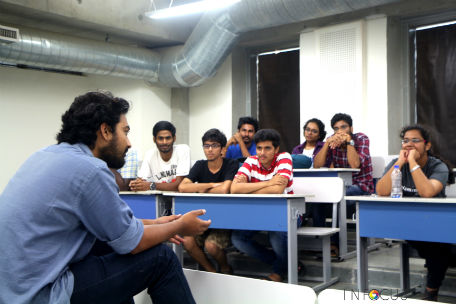
Hyderabad: Indian Institute of Technology Hyderabad hosted its first ‘Human Library event ‘ on Sunday, 08th October 2017.
The idea of ‘Human Library’ was conceptualized in the year 2000 by Ronni Abergel, a social activist, and was first launched in Copenhagen, Denmark. It was designed to build a positive framework for conversations that can challenge stereotypes and prejudices through dialogue. The Human Library now has above 600 book depots worldwide. The Hyderabad chapter was founded by Harshad Fad.

In the events organized by Human Library, individuals from stigmatized sections of the society that are stereotyped based on their ethnicity, religion, sexuality, disability, occupation, social status or lifestyle volunteer as ‘books.’ The readers are free to choose these human ‘books’ from a catalogue. The ‘books’ then share their life experiences with a group of readers and an interactive session follows.

Speaking about the event, Prof. Haripriya Narasimhan, Head, Department of Liberal Arts, IIT Hyderabad, said, “The Department of Liberal Arts endeavours to expose our students to different perspectives of our lives as experienced by ordinary people, so that they can locate their disciplinary practices and objectives within the larger society. The Human Library is one such event which will enable the young minds on campus to understand the deep-rooted prejudices and also how the human spirit allows us to overcome these differences.”

IIT Hyderabad hosted a total of 12 ‘books’ in collaboration with the Hyderabad Chapter of the Human Library. The objective of the event is to help facilitate understanding of individual differences and the dynamics of marginality among the student community.
The reading session comprised the books’ narration of their life experiences followed by an interactive session. The excitement of the students was perceptible as they lined up for the book reading sessions.

A total of five sessions were conducted and each session had approximately 5-8 readers per book. The books entitled “Chains of Freedom” and “Price of Smiling” were particularly popular with the readers. The book “Price of Smiling,” narrated the inspiring story of her struggle with clinical depression and her return from the brink of suicide. The session for “Chains of Freedom” was an amalgamation of engaging theatrics, intriguing propositions and astounding adventures. The book spoke about the politics of identity, nationalism and boundaries while justifying his vision for a world without borders.
The idea behind this event is that the readers should go back a bit wiser for having read these books and the books a bit happier for having interacted with such bright and enthusiastic readers.

Thursday, October 5, 2017

The glaring lack of women in STEM fields in India is our own fault - Hindustan Times

Stuck in a deeply entrenched patriarchal society, Indian women face many battles in medicine, science and technology. Families who expect women to conform to traditional gender roles and a deeply biased workplace — all contribute to women leaving jobs in STEM fields
EDITORIALS Updated: Sep 28, 2017 16:56 Ist

Hindustan Times


Science, technology, engineering, and medicine – together known as ‘STEM’ fields – suffer from a glaring lack of women, especially in India. This should be eliciting far more worry than it is. Year after year, in school exam results, we hear of how girls have outshone boys, but when it comes to those who take up research in later life, the number of women is minuscule. This means that many of our best brains that showed the maximum potential do not pick research as a career.

Stuck in a deeply entrenched patriarchal society, Indian women face many battles before they can make it to the highest levels of STEM. As President Kovind noted at the Council of Scientific and Industrial Research’s (CSIR) 76th foundation day, of all those who joined an Indian Institute of Technology (IIT), only about 10% were women. Those in PhD and post doctoral research are even fewer. This situation, as the President correctly observed, is distressing. The scientific community is known to be hard on women, constantly making it hard for them to rise in the field. A Kelly Global Workforce Insights (KGWI) survey on Women in STEM showed that 81% of women in STEM fields in India perceived a gender bias in performance evaluation. Such hostile work culture, coupled with the pressures of home is making women leave STEM professions.

Earlier this year, a promising PhD scholar from IIT Delhi committed suicide, allegedly under pressure from her husband and in-laws for dowry and to give up her research dreams. Her father, in despair after her death, had told the Hindustan Times that he wished he had saved money for her dowry instead of investing in her education. This is one of the most fundamental problems. Women have to handle not just the blatantly misogynist scientific community, but also the pressures of family to conform to traditional gender roles. Many women are routinely told that they cannot be hired for high ranking positions because they either have children or will have children in the future. The underlying assumption is that a woman with a family will give more attention to her home than her job.

The loser in this scenario is not just women who do not get a chance to chase their dreams; but also science itself, which fails to benefit from other points of view. It is not enough to lament the lack of women in STEM fields. Government agencies, universities, and society must work together to ensure that our hiring practices are free from the insidious sexism that keeps women from achieving their full potential.

Wednesday, September 27, 2017

IIT graduate jumps to death from 23rd floor of DLF Magnolias in Gurgaon


The police said he was grappling with depression and was dissatisfied with his job

GURGAON Updated: Sep 26, 2017 09:04 Ist


Hindustan Times

The man jumped from his uncle’s residence in DLF Magnolias.(HT File Photo)

A 26-year-old graduate of the Indian Institute of Technology, Kanpur, allegedly committed suicide by jumping to death from the 23rd floor of a posh apartment building on Golf Course road late Sunday evening. Police said he was grappling with depression for the last 16 months.

The deceased, identified as Ankit Wadhwa, allegedly jumped from his uncle’s apartment in DLF Magnolias as he was depressed and dissatisfied with his job.

Wadhwa hailed from Sriganganagar in Rajasthan and used to work in Mumbai. He was also planning to get a masters degree in business administration, said Gaurav Phogat, station house officer of Sushant Lok police station.

He had come to Gurgaon on Sunday to appear for an entrance test to a management institute. However, late Sunday evening, he jumped from his uncle’s apartment and died, the police said.
The parents of the deceased have been called and the body would be handed to them after a post-mortem examination. Ravinder Kumar, a spokesperson for Gurgaon police, said that action has been initiated under Section 174 of the IPC at the Sushant Lok police station.

xxxxxxxxxxxxxxxx
The Hindu

STAFF REPORTER
GURUGRAM, SEPTEMBER 26, 2017 02:18 IST

A 26-year-old IIT-Kanpur graduate allegedly leaped to his death from the 23rd floor of a high-rise at DLF Magnolias here early on Sunday.
Ankit Wadhwa, a resident of Sri Ganganagar in Rajasthan, had come to Gurugram to appear for his GMAT exam in Delhi on Monday. He was staying at his paternal uncle's flat on Golf Course Road.
He went to his room after dinner around 10:30 p.m. and was allegedly found dead on the ground floor four hours later. The matter came to light when the security guard heard a loud thud and discovered the body lying in a pool of blood. No suicide note has been found, the police said.
‘He was depressed’
His uncle and aunt and the couple's son and daughter-in-law were inside the flat when the alleged incident took place around 2:00 a.m.
Station House Officer, Sushant Lok Police Station, Inspector Gaurav Phogat said that Ankit had been depressed for over a year and was undergoing treatment for the same. “He had some career-related issues and was depressed,” said Mr. Phogat.

He had earlier worked with J.P Morgan company in Mumbai for over two years, said the police. The family has been informed about the incident and the body will be handed over to them after post-mortem, the police said.

Thursday, September 21, 2017

IIT Kanpur needs to call out ragging and sexual abuse on campus - Daily O


At least 22 second-year students verbally and sexually abused a group of juniors on campus earlier this month.


The IITs are at it again, doing what they've always done with great efficiency. It's a simple, three-part process.

1. Turn a blind eye to rampant sexual abuse and/or psychological torture on campus — until the sh*t well and truly hits the fan.

2. Watch aghast as a massive incident inevitably happens — like the one at IIT Kanpur earlier this month, where at least 22 second-year students verbally and sexually abused a group of first-year students.

3. Employ every trick in the book to deny, obfuscate or otherwise play down said incident, in order to protect a rapidly eroding, soon-to-be-non-existent "reputation".

Here's the Times of India report on what happened: Note the deputy director of the institute saying that "more than one student" was harassed by the 22 second-year students (this number, 22, is also courtesy a professor's blog and Facebook posts, not any official communication from IIT Kanpur). I seem to remember from my own math classes at IIT that "more than one" can mean as little as 2 (the number of people who killed themselves in my hostel, during 2007-2012, my stint at IIT Kharagpur; if you include other hostels as well, the toll reaches double digits for these 5 years alone) or as many as 16 (the number of confirmed student suicides in IITs alone from 2008-2011).


So which was it, sir, 2 or 16? Or was the number so embarrassingly large that you had to fall back on your usual lies and deception?


Tuesday, September 19, 2017

Mumbai woman kills self five months after wedding, husband, in-laws arrested - Hindustan Times


Summary: The Dharavi police said Puja Kamble and Tushar Kamble, 25, fell in love after meeting at a workplace four years ago and tied the knot on April 23. The claim Puja was mentally sick and had undergone treatment for it through an NGO.”

READ:Delhi: 24-year-old woman set on fire by husband, in-laws, suspected dowry death Also, Tushar’s mother Pratiksha, 49, used to taunt her that her father gave them low quality materials in dowry. After her suicide, her father registered an FIR under section 306, 498 A and 34 of IPC against the trio. Soon after their wedding, Puja saw Tushar celebrate a woman’s birthday in Borivli national park when he had told her that he was at work.

A man, his brother and mother have been arrested for allegedly torturing his 23-year-old wife to the extent that she was forced to kill herself at their residence in Dharavi. The Dharavi police said Puja Kamble and Tushar Kamble, 25, fell in love after meeting at a workplace four years ago and tied the knot on April 23. Puja’s father, a videographer, also gave dowry to Tushar’s family. Soon after their wedding, Puja saw Tushar celebrate a woman’s birthday in Borivli national park when he had told her that he was at work. When she confronted him, Tushar and the other women with him beat her up, said the police , As Reported By Hindustan Times

According to the Newspaper,Also, Tushar’s mother Pratiksha, 49, used to taunt her that her father gave them low quality materials in dowry. 

READ: Should’ve saved for dowry instead of IIT, says father of PhD scholar found dead On July 12, Puja filed a non-cognizable complaint under section 504 of IPC against her in-laws at Dharavi police station. A day before she committed suicide on September 10, her neighbour had called her father to inform him that she could hear Puja scream after being abused and assaulted by her in-laws. After her suicide, her father registered an FIR under section 306, 498 A and 34 of IPC against the trio. Senior police inspector Suryakant Bangar of Dharavi police said, “She did not leave a suicide note but based on other evidences and her father’s FIR, we have arrested the three. 

Narayana student ends life - The HANS India


THE HANS INDIA |   Sep 18,2017 , 12:04 AM IST

Vijayawada: An Intermediate senior student of Narayana IIT College at Gudavalli allegedly committed suicide by hanging at his hostel room on Sunday.

According to reports, the boy was identified as P Eswar Reddy of Piduguralla in Guntur district. He was chided by a lecturer during the examination on Sunday morning. The lecturer scolded him for indulging in mass copying. The lecturer was also thrashed him, it was alleged.

Unable to cope with the insult meted out to him at the hands of lecturer, the hurt student directly went to his hostel room from the examination venue and hanged from ceiling fan.

The incident rocked the student fraternity as they have been agitating for Minister Narayana’s scalp. The body of student was at Kamineni Hospitals where the students and leaders of student unions gathered.

The students alleged that action was not taken against the college management as it belonged to Minister Narayana. They accused him of misusing authority to suppress such cases of student suicides. The students raised slogans against the Minister and demanded that the Chief Minister remove him from the Cabinet. 

The Minister was not showing much interest in the college affairs and as a result the students are being treated badly at his institutions, the agitating students alleged.Both the college management and the police are not available to the media to take their version in this case.

Wednesday, September 13, 2017

How Many Times Did Anitha Need to Prove Her Merit to an Undemocratic Education System? - The Wire


As elite scientific institutions ignore socio-economic realities to bypass reservation in the name of quality, students from marginalised backgrounds continue to suffer.

Students during their protest demanding justice for S. Anitha and urging the central government to ban NEET. Credit: PTI

India’s higher education system has claimed yet another Dalit life as the struggle to democratise it meets with another failure. Anitha, who excelled in the Tamil Nadu State Board high school examination, had to resort to suicide when all doors of getting a medical seat were closed on her. This resulted from the Madras high court and Supreme Court quashing the petition to exempt Tamil Nadu from the ambit of the National Entrance-cum-Eligibility Test (NEET), in which Anitha was herself an impleader.
Her death, 20 months after the suicide of Rohith Vemula at University of Hyderabad, reaffirms that there is an effort to keep higher education an exclusive domain, inaccessible and inhospitable to students from the most marginalised communities.

Anitha was aware of the ways in which higher education is becoming exclusionary. She mentioned these problems in her appeal to the Supreme Court – that it was not about her aptitude but a different syllabus that required her to take coaching classes that she could not afford. She questioned the implicit distrust of state board examinations, which results in the creation of national gatekeeping mechanisms like NEET, Indian Insutitute of Technology Joint Entrace Examination (IIT-JEE), All India Engineering Entrance Examination (AIEEE) and All India Institutes of Medical Sciences (AIIMS) exam in the name of standardisation.

We wouldn’t expect the high court and the Supreme Court to intentionally take decisions that aid the keeping of marginalised communities out of the higher education system. Then, under what circumstances does the judiciary play into the hands of the problematic discourse of merit that by design is exclusive in nature? Why, even after 67 years of being a constitutional republic, do we continue to fall into such traps that don’t allow the excluded groups to access opportunities of higher education?

Judiciary’s recurring blindness to ‘positive discrimination’  
To understand the root of this problem, one needs to revisit the year when the constitution of India came into operation and the petition filed by Champakam Dorairajan opposing caste-based reservation in electoral constituencies. In 1950, like 2017, it was the Madras high court and Supreme Court that took the stance that providing reservation for political and educational opportunities is in violation of Article 15 of the constitution, which prohibits discrimination on the grounds of religion, race, caste, sex, or place of birth.

In response to this problematic reading of Article 15, the first amendment to India’s constitution was brought to encourage “positive discrimination,” and clause 4 was added to the article, which stated that “Nothing in this article or in clause (2) of Article 29 shall prevent the state from making any special provision for the advancement of any socially and educationally backward classes of citizens or for the Scheduled Castes and the Scheduled Tribes.”

The judiciary, dominated by savarna men, has time and again shown caste and gender blindness in the name of equality while completely ignoring the lived experience of disadvantaged sections of society. This has led to a long history of mistaken judgments, like in the case of NEET.

How IITs and AIIMS have placed an unfair burden on marginalised students

Since 1950, the struggle has been to keep the spirit of this ruling alive despite efforts to challenge the democratisation of education. In the higher educational context, it begins with the focus on setting up elite institutions in science and technology, with IIT Kharagpur being set up in 1951 and AIIMS in 1956.
With the aim of nurturing the “best minds,” the entrance examination for IITs and AIIMS was devised to select “meritorious” candidates who could then be further supported. The aims of social justice were completely ignored in this endeavour as the reservation policy was introduced much later in 1973, that too with a clause that institutes of national importance can formulate their own schema instead of remaining accountable to the public.

Many elite scientific institutions continue to use this clause to completely bypass reservation in the name of quality. This fallacy of putting quality and merit in opposition to reservation has been the root of the current crisis in higher education, whose repercussions continue to fall upon the Dalit and Adivasi students.

This discourse of quality and merit in education, which is being gauged by isolated entrance examinations, does complete disservice to both the idea of merit and the constitutional aims of social justice. This dominant educational psychology, which locates intelligence in an individual, completely ignores the role of socio-economic privileges in being able to access support systems, be it nutritional, educational, economical, or social.

What more did Anitha need to do?
For a student like Anitha, a girl from Dalit background whose father is a daily wage labourer and with no mother, its evident that her access to support systems was decimal compared to a student from the middle class or an upper caste. Given the lack of a level playing field, can merit only be measured by the student’s performance in a common entrance test and not take into account the social realities that play a huge role in her access to opportunities? Despite her disadvantageous background and situation, Anitha was able to score 98% in the state board examination.

Did she still need to prove her merit by performing well in a national-level examination conducted by the CBSE board, which has a different syllabus than the state-run government schools that most disadvantaged students access? This is why Anitha petitioned the court – because she knew that adapting to NEET for young aspirants like her would involve the expensive coaching infrastructure, which they simply cannot access.

Tamil Nadu has been witnessing massive protests by students unions and youth outfits ever since the death of Anitha. Credit: PTI

She approached the court because she knew that the distrust of people like her was becoming institutionalised by exams like NEET, IIT-JEE, AIEEE and AIIMS. Even colleges like Birla Institute of Technology and Science, Pilani, which earlier admitted students based on state board results, have moved to a national-level examination. The pertinent question to ask here is why is there such an impetus for centralisation of entrance exams for higher education and what role do they actually serve?

Discrimination begins at school
Here, one needs to make a distinction between school and higher education in India because the problem lies in the cusp. In the context of schooling, there is a prevalent myth that the “quality” of government schools are bad in comparison to the private schools, and thus there has been a mass exodus to private schools for anyone who can afford.
Private schools have also tried to moderate their fees to attract lower classes who see education as the only promise of a better future. Although there has been enough research to challenge this myth by comparing the learning levels of students from both government and private schools, it persist.
However, when it comes to higher education, there is no doubt that public universities like IITs, AIIMS, Indian Institutes of Management, Jawaharlal Nehru University, University of Hyderabad and Delhi University are coveted institutions for most aspiring students.
This also has to do with the spending of educational budget, where the lion’s share goes to few institutes of higher education while neglecting primary and secondary education. The option to exit the public institutions for a more exclusive private one is not available in the higher educational space. Thus, while government schools have been exited by the upper castes on the pretext of quality, and any attempt to democratise private schools through the Right to Education is met with stiff opposition, exiting public universities in a similar fashion is not an option. Hence, the stakes are elevated in claiming the higher educational space, and only reservation policies continue to provide a glimmer of hope for democratising these spaces. The only way to subvert this democratic aim is by putting more roadblocks, such as that of gatekeeping examinations, which would eventually tire out the marginalised communities in their struggle to enter public spaces.
Anitha was at this cusp between school and higher education, and the promise of transforming her life by getting into a government medical college was real. With state board examination results, she would have easily secured a seat in a premium college. However, that would have only been the beginning of a long struggle inside the campus where reservation is used as an excuse to undermine one’s merit and the place they deserve in a university.
The 2007 Thorat Committee report explicates the magnitude of caste discrimination in elite institutions like AIIMS where not only students but also faculty from SC/ST background are continually excluded in the garb of being non-meritorius and undeserving.

A file photo shows parents of the students preparing for medical entrance exams forming a human chain to protest NEET. Credit: PTI

I observed a similar discrimination during my undergraduate studies at IIT Delhi where I saw an elaborate framework of ‘graded inequality’, to use Ambedkar’s conception of caste, at play based on the all India ranking (AIR). This AIR, which is different for general and reserved seats, along with one’s socio-geographic location, known from one’s name, appearance and spoken language, would determine the graded respect one commanded in social life. With an utter disregard towards social justice, savarna students would continually humiliate SC/ST/minority students by employing the (false) merit argument, eventually making the higher educational space hostile for them.

Many such students who have been unable to tolerate this undignified life have resorted to committing suicide. This is viewed as a weakness of that individual to not be able to cope with the high standards of the university, further reifying the anti-reservation stance.
Amebdkar knew that the biggest challenge to democratisation of India is the graded hierarchy of caste and gender, and therefore, without annihilating caste, all our efforts would boil down to nothing. However, instead of dealing with caste directly we have only managed to hide the exclusion through the discourse of ‘individual’ merit. Generations then accumulate this privilege. Public universities have become the most contested spaces as they allow for the possibility of democratising exclusive spaces and becoming exemplars for the society.
However, what we have seen with Anitha, Vemula and many others is that all our attempts towards democratisation are constantly demolished by Brahminical appropriation of merit and quality. To annihilate these new mechanisms of exclusion and truly democratise the universities, we need to challenge the gatekeeping examinations and anti-reservation rhetoric that continue to undermine constitutional ideals. Such discourse simply has no place in the republic of India.


Asim Siddiqui teaches philosophy at Azim Premji University, Bangalore.

Tuesday, September 12, 2017

Huge gap in demand and supply of medical practitioners for mental health, says Neerja Birla - Money Control

Sep 10, 2017 10:46 AM IST | Source: Moneycontrol.com


WHO said that India has 15.7 suicides per 100,000 people in 2015. The average for South East Asia was 12.9 suicides per 100,000 people.


By
M Saraswathy
Special Correspondent
Moneycontrol


Every three seconds, a person attempts suicide. And if you notice the red flags on time, you will be able to prevent it. 

Neerja Birla, Founder and Chairperson of Mpower, a firm specialising in offering care and allied services for mental health said there is still a huge gap in treatment for mental health issues in India.

September 10 is observed globally as World Suicide Prevention Day to create awareness about mental health and also help observe early signs to aid prevention. The World Health Organization estimates over 800,000 people die by suicide each year, that’s one person every 40 seconds.

“In India, there are 3800 psychiatrists, 898 clinical psychologists, 850 psychiatric social workers and 1500 psychiatric nurses. This is very small. This translates to 3 psychiatrists per million people and according to WHO, this is 18 times fewer than the Commonwealth norm which is 5.6 psychiatrists per 100,000 people,” said Birla. She said the country is short of 6200 psychiatrists.

In March, the Mental Healthcare Bill was passed by the Parliament that decriminalises suicide and encourages coverage for mental health-related ailments. Birla said this has also also increased the funding to centres of excellence in mental health which will boost efforts to create awareness and provide support.

However, basic facilities like insurance is still being talked about. Regular medical reimbursement programmes offered by corporates also do not cover either medication or visits to the therapists for mental health issues.

If you are running a fever, you never see any stigma associated with picking up the phone and talking to a doctor. There is a certain schema there that anything to do with our mind makes us weak and vulnerable. We do not want to then admit to it,” said Birla.

Mpower, which started its Mumbai centre in May 2016, is now looking to expand to other cities as well. “Opening our first counselling cell at BITS Pilani, Goa for the campus. We want to take it to Pune and Bangalore and also want to target university campuses and have reached out to instituites like IIT Madras,” she said.

While Mpower and other institutions like them have been reaching to educational institutes and corporates, Birla said that it is still early days. In their outreach programme, Mpower offers free workshops to schools and also encourage them to take a student-assisted programme. They will also be opening up a helpline next year.

“In Mumbai, we reached out to 180 schools in Mumbai we reached out too, but only five have said yes. Why are we shirking it under the carpet and not giving it due importance? People are talking about it but when it comes into taking action, it is slow,” she added.

According to research, the first one minute where a person contemplates suicide is the most crucial. Birla said that through their campaign, they have been trying to create an awareness about this and encourage individuals, especially youngsters between the age of 18-30 years to seek help and also listen to people in need of help.

Friday, September 8, 2017

The online lifesaver - Indian Express

The online lifesaver

By Shruthi HM  |  Express News Service  |   Published: 06th September 2017 09:39 PM  |  

CHENNAI: An engineering student in a premier institution in the country commits suicide ahead of campus recruitment, in anticipation of failure to secure a job. The campus recruitment is yet to begin and the student is good at studies. However, just the fear of failure in campus recruitment drives the student to take an extreme step.
The incident in question took place in 2008 and the student was entrepreneur Richa Singh’s friend. This disturbing incident drove Singh, an IIT Guwahati alumnus, to start an initiative of her own to reach out to people in need of help. Her efforts materialised in the form of YourDost, an online counselling platform, which today reaches out to at least 2,000 people on a daily basis.
Co-founded with Puneeth Manuja, an IIM-B alumnus, YourDost provides affordable mental health care. “Richa’s friend committed suicide, in anticipation that she would not get placed and this was even before the placement started. Despite being a gold medallist in computer science (NIT Calicut), I myself did not get placed for the first few months. This incident connected with me immediately. When I was going through the crisis I didn’t have a support system. My parents are from UP and I was alone in Calicut. I felt that my friends would be laughing behind my back thinking a gold medallist is not smart enough to clear interviews,” Puneeth Manuja said, speaking to City Express about his journey leading to YourDost.
The company, in its present form of online counselling started in 2014, before which it existed as a blog. When Singh and Manuja began researching about counselling options, they realised that the stigma of seeking a professional’s help was huge and especially so in the case of men. Moreover, they also noticed gaps in the availability of counsellors, apart from affordability. “What we realised during the research before starting this initiative is that the stigma that is there in our society is huge. Forget professional advises, we don’t even express ourselves in front of our friends. That vulnerability is huge. There is fear of judgment. We all migrate for jobs and hence we won’t have support systems. This made us start YourDost,” Manuja added.
YourDost attempts to make counselling affordable by providing sessions priced between Rs 400 and Rs 600, as opposed to Rs 1000 and above per session which any counsellor would charge in an urban area. That apart, the first session is offered for free, enabling users to test waters. Since it’s an online session and provides the user an option to choose any user name, it also provides users the anonymity to open up without inhibitions.
Further, this online platform also addresses the issue of immediacy, Manuja explained. “I may
want to express my problems now and might not want to open up tomorrow. Since it’s a 24/7 support system, users can access professional help at any point in the day,”he added.
As much as 60% of the user base for the platform are from urban areas while the rest belong to tier 2 and tier 3 cities. While 65%  of users are working professionals, the rest are students. Majority of the users are in the age group of 18 and 35. In terms of issues major category is relationships - both pre-marital (body shaming, self confidence issues, not being able to find a match, break up) and post marital, especially in early years of marriage. Users also seek help to deal with work related issues including career confusion, conflict at work place, work life balance etc, according to Manuja.

Your Dost has raised two rounds of funds till now. The angel round and the seed round. They have raised $1.6 million. With a team of 20 people, YourDost is currently looking at making the business more sustainable to reduce dependency on funding.

Wednesday, September 6, 2017

It's Time To Kill NEET And Return Education To The State List - Huffington Post


We as a nation owe an apology to Anitha.

04/09/2017 4:49 PM IST | 
G Pramod Kumar Contributing Editor, HuffPost India
          HINDUSTAN TIMES VIA GETTY IMAGES

There's a lot of anger and anguish that's still erupting in Tamil Nadu over the suicide of Anitha, the Dalit girl who was the visible face of the state's resistance to the central government's national medical entrance examination, the NEET.

For Anitha and thousands of meritorious students like her, who would have otherwise gotten into medical schools, what was snatched away was their hard-earned sovereign right to higher education in an increasingly centralising India.

In a "Union of States", where the architects of our Constitution had rightly ensured that the states had sufficient autonomy to manage their affairs, instruments such as NEET is an anomaly. In the case of Anitha, it was also a symbol for the tyranny of the Centre that took away what rightfully belonged to her and the states. NEET was a strange beast that young people such as Anitha were unable to figure out because her education under the Tamil Nadu Uniform System of School Education (Samacheer Kalvi) was not meant for an unsuitable evaluation of her merit at a national level. NEET was ugly and scary for her and thousands of others.

The Centre Cannot Control Education In States
Presently, NEET is one of the biggest injustices in India's uneven education system. It has created an inappropriate filter that doesn't find real merit, but lets only those with special entitlements pass through. Getting these entitlements, such as crash-training in cracking MCQ requires access to an expensive, premium coaching that people such as Anitha in the hinterlands of India cannot afford. If states such as Tamil Nadu had been able to expand the access to education even to the remotest areas because of years of hard work, filters such as NEET mercilessly roll them back.

Education cannot be taken out of the linguistic, socio-cultural and autonomous context of Indian states.

There was a purpose why the Constitution had left subjects such as education and health - the pillars of human development - with the state government. And that's precisely why every the Indian state has its own "state board" for school education and appropriate syllabi. Education cannot be taken out of the linguistic, socio-cultural and autonomous context of Indian states. In fact, the Kothari Commission, that was convened in the 1960s to advise on education in the country, wanted education to remain with the state despite its recommendation for a nationwide standardisation.

Kerala, the jewel in India's human development story, made all its early strides in education with this autonomy, and Tamil Nadu has produced high quality doctors, surgeons, engineers, scientists and academics with its own educational system and premier institutions. But when it came to NEET, Kerala topped the list in South India with 79.77 pass percentage, while Tamil Nadu fell to the bottom with 41 per cent.

The reason was not quality or merit, but access. This is how unjust NEET is.

Politics Surrounding NEET
Had former Tamil Nadu chief minister Jayalalithaa been alive, Anitha probably wouldn't have died. Jaya had clearly understood the need for autonomy in education and the unsuitability of entrance examinations in her state. She abolished them in 2005 and had vowed to put an end to NEET if she came back to power in 2016. Although she did return to power, she was mostly sick, and had passed away at a crucial time. Jaya had even promised new legislation if things didn't work. But her legacy-holders - the splintered AIADMK that is obsequious to the BJP-ruled centre for power and safety - are hardly interested.

Even without entrance examinations, Tamil Nadu still tops the country in both quality and numbers of technical talent. Its Anna University campus, which doesn't have an entrance test, is as prestigious and coveted as the IIT in Chennai, and about 1.2 crore students study under Samacheer Kalvi.

A subject in the concurrent list makes both the Centre and the state equal partners, but given the Centre's constitutional upper hand, it never works that way. NEET is a classic example.

Joining the statewide protests against Anitha and NEET, DMK leader MK Stalin has promised to bring education back to the state list and ensure that nobody meets with Anitha's fate again in Tamil Nadu. DMK had been among the most vociferous voices for state autonomy in its early years, but has long since watered down its policy thanks to its opportunistic alliances with national parties that ruled Delhi.

Had DMK been serious, it could have blocked NEET because it was a creation of the UPA. As Jaya once said, the DMK even had a second chance when the UPA government chose to appeal against a Supreme Court verdict that abolished NEET in 2013. In fact, it was during the same time, that Kapil Sibal, the then human resources development minister had developed such fancy ideas of unified screening tests for a complexly diverse country (common entrance exam for all engineering colleges across India that receive some funding from government of India). Creating such standards to national institutions is understandable, but imposing them on state institutions that are built on a different understanding of social justice and development ethic was totally insane. In terms of character, it's similar to the imposition of Hindi, that Tamil Nadu rose against and defeated on multiple occasions.

The only way to escape this absolutist injustice is to bring education back to the state list
In fact, most of the blame for today's mess should go to the Congress because it was Indira Gandhi who shifted education, which had been constitutionally part of the state list, to the concurrent list in 1976. The brutal suzerainty of emergency ensured that there was neither consultations with the states nor, resistance from them. Evidently, the Swaran Singh Committee that recommended such a move because the government then thought education required national policies, reflected Indira Gandhi's emergency ethos of a centralised India. A subject in the concurrent list makes both the Centre and the state equal partners, but given the Centre's constitutional upper hand, it never works that way. NEET is a classic example.

The Way Forward
The only way to escape this absolutist injustice is to bring education back to the state list, a larger campaign for retaining the constitutionally guaranteed autonomy of the states in letter and spirit. It needs icons such as Jaya, who defiantly stood up for the rights of the states. In a country which has Orissa and Kerala - and BIMARU states and southern India - at the two ends of the diverse development spectrum, one size doesn't fit all. Imposing such one sizes is to disincentivise good governance and innovation by enterprising states, and to pull all of them down to sub Saharan standards.

As Jawaharlal Nehru said in his Discovery of India, "India is a geographical and economic entity, a cultural unity amidst diversity, a bundle of contradictions held together by strong but invisible threads." He even called it a "myth and an idea" (Salman Rushdie also said something similar). The constitution embodied this reality, but politics of hegemony chooses to ignore it.

Finally, the NEET-advocates must learn from a tiny Cuba, that's as small as Uttarakhand in terms of population. It doesn't have NEET or any such unreasonable screens, but trains doctors by the thousands, half of them from different parts of the world. They deploy doctors all over the world where they need them, whether it's an Ebola-hit Liberia, where nobody wanted to go, or a Quake-hit Pakistan. It runs world-class institutions in rich countries such as Qatar and poor countries such as Timor Leste.

 Majority of their graduates end up serving government institutions, and hence the poor, because of the value system that they imbibe during their education. (Cuban model also calls for free medical education)

In comparison, in India, absurd centralist policies are killing its homegrown advantages, and the people such as Anitha who co-create them.


Madras HC seeks IIT director's help in banning Blue Whale game - Indian Express

By PTI  |   Published: 04th September 2017 02:35 PM  |  


MADURAI: Taking a serious view of the Blue Whale Challenge game, the Madras High Court today directed the Central and Tamil Nadu governments to explore possibilities of banning it.
Initiating suo motu proceedings in the matter, Justices K K Sasidharan and G R Swaminathan of Madurai bench issued notice to the Union Information and Broadcasting Secretary and state Home Secretary and IT department and made several suggestions.

The bench asked them to find out the possibility of banning the game and directed that IIT-Madras Director be impleaded in the case to offer suggestions to ban such online games.

During the hearing of the matter, the state government informed the court that the student who ended his life here had shared the game with 75 others. However, all of them had been prevented from playing it, the government counsel added.

The judges suggested to the state DGP and Home Secretary that severe warning be issued to those who shared the 'dangerous' online game with others.

On September 1, the court had said it would take up the case suo motu when Krishnamurthy, an advocate, made an appeal for a direction to the Union Information and Broadcasting Ministry to ban such games.

The advocate made the plea after 19-year old Vignesh, a private college student, allegedly committed suicide on August 30 here after playing the game.

Vignesh had reportedly told his friends that he was "crazy" about the game and also told his parents that he was getting isolated due to his addiction for it.

Later in a suicide note, he had said "The game was a devastating one... once you enter it, you would not be able to come out."

The bench also said monitoring should be intensified to prevent further spread of the game through sharing.

The court stressed on the need for creating awareness among students against playing such "dangerous" online games in educational institutions.

To this, CB-CID police officials present at the court said they were keeping a close watch and taking steps to freeze the game.

Warning had been issued against those sharing and downloading the "deadly" online game, they added.

The state government also informed the court that Vignesh had shared the game through Facebook and "Share it" App with 75 others. All had been prevented from playing the game, it said.

The IT department should also give suggestions to prevent the sharing of such "dangerous" online games, the bench said and posted the matter for further hearing to September 7.

The Blue Whale Challenge is reportedly a suicide game in which the player is given certain tasks to complete over a period of 50 days and the final task leads him or her to commit suicide.
The player is also asked to share photos after finishing each challenge.

The game has claimed several lives worldwide.

xxxxxxxxxxxxxxxxxxxxxxxx


India.com
Chennai, Sept 4: The Madurai bench of the Madras High Court on Monday directed Tamil Nadu police to take strict action against those who share the ...


Monday, September 4, 2017

Anitha suicide: Death of drowntrodden common in unequal society, says filmmaker Pa Ranjith - India Today


Ranjith, who is also the director of Rajinikanth's Kabali and Kaala stated that the death of down trodden people in a society which is unequal is unfortunately common.

 | Edited by Bijin Jose
Chennai, September 2, 2017 | UPDATED 17:40 IST


HIGHLIGHTS
  • Pa Ranjith said that death of downtrodden people was common in an unequal society.
  • Anitha, an MBBS aspirant, ended her life on Friday.
  • Ranjith also slammed state and Central governments.

Following the footsteps of superstars Rajinikanth and Kamal Haasan, noted filmmaker Pa Ranjith too has come forward to express grief over the  suicide of Ariyalur Dalit girl Anitha .

Ranjith, who is also the director of Rajinikanth's Kabali and Kaala stated that the death of downtrodden people in a society which is unequal is unfortunately common.

Anitha, an MBBS aspirant, ended her life on Friday after discovering that she cannot become a doctor due to the introduction of National Eligibility and Entrance Test (NEET) exams.

Anita scored 1,176 marks out of 1200 in class 12 and a cutoff over 196. Had there been no NEET exams, she could have easily got into a medical college.

However, the introduction of NEET even after the state government's continuous promise to get exemptions, Anitha got 86 for 700. Anitha took forward the legal fight against NEET stating that a common exam is unconstitutional when the downtrodden are not given equal chance.

But, after the Supreme Court's verdict and the poor coordination of the State government, it became evident that Tamil Nadu cannot get exemption from NEET anymore.
Anitha was a daughter of a daily wager and could not afford any special coaching or did not have more chances.

Pa Ranjith, who went to Ariyalur to pay his last respects to Anitha claimed said, "even after acquiring very good marks in class 10 and class 12 her dreams were shattered as more harsh weapons like NEET were being created. The main objective seems to be like curb the entry of the downtrodden into institutions just like IIT."

The Kaala director stated that an innocent girl decided to take her life after battling all the odds and coming to realise that she cannot succeed. He sad that the incident only raised the question as to for whom does the government function.

Countless protests were seen all across the state by student bodies and political parties and the blame has fallen upon both the state and Central governments. Protestors claimed that false hope was given to children about NEET.

Also Read:


Saturday, September 2, 2017

Rising student suicides: Pressure to perform tightening the noose - TNN


Preeti Biswas | TNN | Sep 1, 2017, 08:16 IST

HYDERABAD: A spurt in student suicides across Telangana, including those by intermediate and school students, has sent alarm bells ringing after as many as 25 cases were reported in the last two and a half months. 

Student suicides are becoming increasingly common in Hyderabad, considered the capital of IIT coaching after Kota in Rajasthan. This, child rights activists alleged, is because parents and commercial coaching centres are pressurising students into striving for unrealistic goals. 

The recent case of a 19-year-old second-year intermediate student of a corporate college in Bachupally stands testimony to this.His was the third student suicide to rock the city in August this year. 

"Of the 25 suicides that were registered in the past few months, 12 were boys and 13 were girls. Nine of the 25 cases were reported from Hyderabad and Rangareddy districts," said Achyutha Rao ,honorary president, Balala Hakula Sangham, a child rights NGO, which has filed a petition with the State Human Rights Commission (SHRC), seeking action against educational institutions over the rising cases of student suicides. 

The SHRC issued a notice to the principal secretary of education, Ranjeeva Acharya, on Thursday , seeking a report on the increasing student suicides in educational institutions by November 16, 2017. 

According to experts, those preparing for various exams are most vulnerable. "Society needs to realise the im portance of talking to youth about the stress they go thro ugh during this time and pa rents who may be setting un realistic career expectations for their children," said Mur lidhar S, chief executive offi cer & founder, Lodestar Care er Guidance.

Under fire from child rights activists, manage ments of educational institu tes blamed the rising suicide rate on parental pressure. 

The Narayana Group, which runs a chain of junior colleges, has now decided to formalise the counselling process to prevent student suicides. "By establishing a separate wing, we have deci ded to appoint 10 qualified co unsellors to counsel students across all our institutions.


We also intend to hold workshops for parents in the next three months to ensure that there is better communication between the students, teachers and parents," said Vijaya Lakshmi, head for the learning and development department, Narayana Group of Educational Institutions. 

Monday, August 28, 2017

IIT-D steps in to make home shift easy for kids - TNN


Krittika Sharma | TNN | Aug 27, 2017, 02:37 IST

New Delhi: Leaving the comfort of home, perhaps for the first time, and being thrust into one of the toughest engineering colleges in India might be an intimidating experience for youngsters. Several suicides and attempts to kill themselves at the Indian Institute of Technology, Delhi, indicate the stress that youngsters find themselves in. The institution has now taken steps to make this transition easier for new students. 

The IIT-D Board of Student Welfare (BSW) has packed old wine in new, more ergonomic bottles, so to say. From making round-the-clock, anonymous online counselling available to students to reintroducing interaction sessions, the administration is doing everything to reassure the freshers and create a cushion of familiar people around them. 

According to V Ramgopal Rao, director, the humanities and social sciences departments submitted a report last month on why students fall back on academics and recommended steps on how to help them deal with pressure. "The departments found that the first semester was the most critical, and if students manage to get through that, they will do well through their course at IIT-D," Rao said. 

In step with the recommendations, the Hindi cell of the institute, till now restricted to translating administrative directives, has been assigned the job of helping first-year students from Hindi-medium schools to cope with academics. Rao himself meets faculty members weekly to sensitise them to student issues. "We tell the teachers to be gentler in their dealings with the students, establish a connection and engage with them on a more personal level," the director explained. 

Teaching assistants have also been deployed to sit from 8pm to 10pm at the hostels and help students with their studies.

As soon as the minors — the first tests in the course — are over, three counsellors will visit each hostel and counsel students on what to expect in the future and how to handle the burden. BSW member Divyam Gupta said this exercise used to be done in the first few weeks after the start of a new session, but was rescheduled to after the minors. Gupta explained this was "because after spending some time here, the students can connect to counsellors better and understand the issues that might crop up".

BSW has also reintroduced the Student Teacher Interaction Council (STIC) dinner, considered last year to be 'ineffective and so terminated. While the earlier dinners were formal and departmental, this year the groups are smaller and the students selected on the basis of common teachers. "In an informal setting, the freshers are able to speak to teachers and teaching assistants in a more relaxed atmosphere," said Gupta.

Sperenza, the annual cultural event, is also expected to help. "Most of the time, only those excelling in particular activities take part because the events are competitive," a student pointed out. "This time, we have organised talks and even meetings with alumni that are non-competitive. These will help newcomers to integrate better."

Monday, August 21, 2017

IIT Roorkee student found hanging in hostel room - TNN

Tapan Susheel | TNN | Aug 19, 2017, 10:46 PM IST

ROORKEE: A post graduate student of Indian Institute of Technology (IIT) Roorkee committed suicide in his hostel room by hanging himself from the ceiling fan on Saturday afternoon.

The deceased, Aman Chauhan, 21, a native of Uttar Pradesh’s Mainpuri, was in first year of MSc (chemistry). His body was found in the institute’s Ganga Bhawan hostel on Saturday around 1 pm.

Security officer of the institute, K P Singh, said that the room was bolted from inside. While no suicide note was recovered, some anti-depressants were found in his room.

Swapan Kishore Singh, circle officer (Roorkee), said, “The reason behind the step is not clear yet. His parents have been informed and postmortem will be conducted once they reach Roorkee.”

Sunday, August 20, 2017

IIT student hangs himself - DNA


Sat, 19 Aug 2017-09:26pm , PTI

The body of a student was found hanging from the ceiling fan of his hostel room at IIT Roorkee today, a senior police official said.

The body of Aman Chauhan, who hailed from Hamirpur in Uttar Pradesh, was found hanging in his hostel room at Ganga Bhawan, SP (rural) Manikant Mishra said.

A first year MSc student, Chauhan is said to have been suffering from depression for some time, Mishra said.

No suicide note was found from the student's room, he said. 

However, a diary has been recovered from the spot, he added.
The matter came to light when Chauhan was not seen by his classmates for a long time in the afternoon.

They reported the matter to the authorities who opened the room and found him hanging from the ceiling fan, the official said.

(This article has not been edited by DNA's editorial team and is auto-generated from an agency feed.)

IIT coaching: While pressure mounts for students, institutes have the last laugh - Money Control

Aug 19, 2017 04:54 PM IST | Source: Moneycontrol.com

While the government appointed Ashok Misra committee had recommended a regulator for the coaching industry, it is unlikely that one will be appointed soon


By


Viru Sahastrabudhhe, or Virus, the popular character from the movie 3 Idiots used the example of the cuckoo bird usurping the crow’s nest to explain how students would need to crush competition to go ahead in life. It holds true when you have merely 11,000 seats across the 22 IITs with 12 lakh applicants every year. 

‘Compete or die’ is the mantra that is followed when it comes to competitive examinations like engineering or medical. More so in the case of engineering, because among the 22 odd Indian Institutes of Technology (IITs), the students only wish to go to the top 4-5 based on the location and placement history. 
When you want a majority of your students to get through to the IITs, a feat that only Super30 has managed year after year, you try to get only the best ones. 

Ads splashed across newspapers state that PACE IIT and Medical, which is a coaching institute for competitive examinations, will hold a scholarship/entrance examination called ‘Ace of Pace’. This will be a test for entry into their engineering coaching institutes across multiple cities in the country. 

A few miles away from Mumbai, Paresh Tutorials is preparing students for the entrance examinations of top engineering coaching institutes for Mumbai and Kota. This centre that opened two years ago, operates during the summers and monsoons to only help students get into the top coaching schools. They, independently, do not offer any engineering coaching. 

Cut to four years ago. It was April 2013. This was the first year that the Joint Entrance Examination (JEE) the test for admissions into the Indian Institutes of Technology (IIT) saw a big shift in the examination pattern. Under the advice of the then human resource development minister Kapil Sibal, a new structure was launched where the marks of the Class XII board examinations were to be considered. Further, All India Engineering Entrance Examination (AIEEE) was scrapped and JEE Mains were introduced with 40 percent weightage for Class XII marks.

This was hailed as a futuristic move aiming to strike at the root of the issue, the private coaching institutes. These changes, he had said, would shift the focus to regular school curriculum and thwart the growth of coaching. Unfortunately, the coaching schools quickly responded by changing their curriculum to include Class XII syllabus as well. 

Four years later, in 2017, the size of the engineering coaching industry has grown to almost Rs 1.2 lakh crore, according to various estimates. And students are going nowhere.

Aakash Chaudhry, Director, Aakash Educational Services (popularly called Aakash Institute) said that their enrollments are growing by almost 15 to 20 percent every year. “We entertain students from as early as class 8 or 9. Scholarships are also offered to students through the Talent Test that we conduct every year,” he said.

These scholarships, which are essentially fee waivers for the coaching provided at the institute, are dependent on how a student performs at the test. 

The JEE examination has been split into two parts, JEE Main and JEE Advanced. Those who secure a rank among the top 2.2 lakh students are eligible for the JEE Advanced examination which is the entry criteria for getting admission into the IITs. For the final admission into the IITs based on JEE Advanced, a student must be among the top 20 percentile in their respective boards, a cut-off for which is released by the authorities every year.

Kota in Rajasthan is considered to be the hub for the IIT coaching industry in India. Thousands of engineering aspirants join hundreds of coaching institutes and integrated institutes that offer both — coaching for engineering entrance as well as regular curriculum for Class XII. Despite the extreme conditions and peer pressure in the city that has also lead to a spate of suicides by students, it is still the top destination every year, even as numbers are coming down. 

Chaudhry, for instance, said that their centre in Kota experienced a lower traffic than previous years. A few other officials from popular Kota institutes said that while the thrust on coaching has not come down, there has been a 5-10 percent dip in the students coming to Kota, since parents want them to study at their place of residence itself. 

In Mumbai, it is a different story. Integrated colleges that had both regular junior college (Class XI and XII) in the morning and coaching classes in the evening have been facing trouble. A case has been filed at the Bombay High Court on this matter and a final decision is pending. 

Chhaya Shastri, Non-Independent, Non-Executive Director at MT Educare and a mentor at their entrance examination coaching arm Lakshya Institute said that traditionally India has been a hub for mentoring and coaching. 

“Yes, there is a rise in the enrollments. Because formal schools are unable to cater to the IIT exams. It involves analytical ability and it is not possible to be imparted at routine hours of the school. But the days of unorganised players is diffusing,” she said. 

Apart from regular coaching, Lakshya Institute also offers a revision tool called Robomate to help students revise the portions at home. Shastri said that apart from hand-holding and monitoring the student, they also have invested heavily in training and development for the teachers. 

For students, this is where they spend the whole day.  Cracking one of the toughest examinations of the country is no mean feat. Sarvesh Mehtani, the JEE Advanced Topper said that Lakshya was like home during JEE preparations. I went home only to sleep. There were either lectures or something important happening all the time. Discussions and doubt solving were always going on and I did not want to miss it. The teachers themselves forced us to take a break with a little fun activity. We played cricket or went to a movie. Motivation happened naturally since everybody was into preparation mode,” he added. 

Until 2012, a student scoring 60 per cent in his/her Class XII board was eligible for a seat in the IITs. There are 32 Boards in India with different patterns of examination and evaluation. 
Taking a cue from offline coaching, online institutes have also flourished. Rajshekhar Ratrey, VP Educational Content, Toppr.com said that their user base has grown over 3 times in last 16 months. 

Ratrey said that the average age of students enrolling for programmes is 15.5 years and the fee is charged for subscription based on the duration. Further, scholarships in the form of fee waiver are given on a case-to-case basis for deserving and meritorious students.

Nikhil Mahajan, Executive Director and Group CEO Enterprise Business, CL Educate (Career Launcher) said that there is a rise of about 15-20 percent in terms of enrolments on a year-on-year basis. 

For physical institutes, the rise in enrollments post the JEE change is clearly visible and is a reflection of the student push to get through at any cost.

Since JEE (Joint Entrance Exam) came into force, Career Launcher has seen a growth of about 30 percent in enrollments as Mahajan said that students are also concerned about their Class XII marks. 

On an average, a 15-16-year-old enrolls for a 2-year programme for preparing for JEE and getting into the IITs. Though, past few years have seen students as young as those in 6th standard start with the foundation programmes for preparing for the engineering entrances.

The fee for coaching institutes ranges from Rs 1.5 lakh to Rs 3 lakh depending on the type of course, duration and location. Fee waivers are offered to students who perform well in the entrance test of the coaching institute. Financial incentives are also offered by institutes like Lakshya to the top scorers/rank holders JEE Advanced examinations. 

Majajan also said that the reliance on coaching institutes, in fact, has increased over the years. As long as there are sudden changes that keep happening in the exam patterns, a situation of panic amongst students will keep cropping up, according to him. 

“With the cutthroat competition, where over 10 lakh students sit for the JEE Mains and only 2.2 lakh qualify for the JEE Advanced and only around 10,000 students make it to the IITs, coaching institutes give that extra academic push to the students, which is required to crack the toughest of entrances,” said Mahajan. 

Apart from intense competition and unauthorised new institutes cropping up every year, issues related to extreme pressure to perform well and fee hikes every year have made parents a worried lot. While the government appointed Ashok Misra committee had recommended a regulator for this segment, it is unlikely that one will be appointed soon. 

As the engineering schools brace for another change from 2018 in the form of another all-India test subsuming all state and national entrance examination, coaching institutes seem to be having the last laugh.