I have a Solution that will reduce pressure on IIT aspirants but do not know how to get this across to HRD Minister of India. Suggestions are welcome. - Ram Krishnaswamy

Search This Blog

Saturday, November 28, 2020

IIT Roorkee Professor Calls Student 'Soft' For Not Attending Class Due To Father's Demise, Draws Social Media Wrath https://thelogicalindian.com/trending/iit-roorkee-professor-calls-student-mentally-weak-for-not-attending-class-due-to-fathers-demise-draws-social-media-wrath-25083


IIT Roorkee Professor Calls Student 'Soft' For Not Attending Class Due To Father's Demise, Draws Social Media Wrath 

The video surfaced on social media platforms received massive outrage from netizens, many of them saying that such incidents were responsible for cases of mental illness, suicide among students. 
The Logical Indian Crew Uttarakhand |
 27 Nov 2020 
 Writer : Devyani Madaik | 
Editor : Shubhendu Deshmukh 
| Creatives : Rajath Credits: Twitter, 
The New Indian Express 

Students of Indian Institute of Technology (IIT) Roorkee decried a professor's deep-seated apathy towards a student, who was unable to attend classes due to his father's demise. During the video/audio call with his students, Professor Patit Paban Kundu from the department of Chemical Engineering referred to the student as 'soft' and 'not at that mental level' after he was not able to attend classes. Stating that the student, Vedant Singh already had less than 50 per cent attendance, Kundu said that he would not excuse the student anymore. Kundu said that he would not provide marks to students with below 75 per cent attendance, as per the rules. 

When the students tried to rationalise Vedant's family problem, along with the dawdling internet connection he had been dealing ever since the online classes have started, Kundu quoted the example of Indian cricketer Mohammed Siraj, who stayed back in Australia and continued the tour with the Indian Cricket Team despite father's demise in India. The cricketer's father passed away on November 20. 

Kundu said that the student did not inform about his father's demise, to which, one of the students said that they were informed by his friend. 

The professor, in an apathetic sound, said that he had no reason to miss the class, given that everyone is studying from home. 

"Death ho gaya hai toh kya, ghar mein hai toh class ni attend karna hai?" Kundu can be heard saying.  

Students time and again reiterated Vedant's situation and said that he might take time to recover from the loss he has incurred. Kundu said the student was taking his class for granted, and he will not provide him with marks. The professor, when informed by the students that the Institute Academic Programme Committee (IAPC) of the institution has decided that marks for the attendance will not be counted for the ongoing session in view of the COVID-19 pandemic, Kundu said that the IAPC could not 'dictate' him to teach. 

The video/audio recording surfaced on social media platforms received massive outrage from netizens, many of them saying that such incidents were responsible for cases of mental illness, suicide among students. 

One of the former students said such kind of problem existed with many more professors of the institution. Kundu later wrote a mail saying he never intended any wrong. 

"On my personal account, I can tell that after the expiry of my father I had to go to South Korea and I had gone there. Maybe you are still not at that mental level, and you are soft. That's the reason you have done all these wrong things which are creating a bad name for our institute." 

He said the students could have approached him in person or mailed him about the same, rather than posting the video on social media. 

"Instead of doing all these, you could have simply mailed me after the class to apologize to Vedanta for not showing apathy (I have shown it; that is even evident when I told all students will be allowed to sit for the exam; the additional comment was that he has to pass the exam)." 

He further stated that in his 24 years of a teaching career, he had worked hard on helping students from failing, and this was one of the attempts. 

"It seems that all of you misjudged me (consult your senior again to judge me). I believe in duty, whatever the consequences are. That's why I was taking the example of Siraj (the cricketer)," his mail read. 

Kundu 'requested' the students to upload another video starting that he has tendered an 'Unconditional Apology' to all the students, also stating that they had misjudged him. 

Highlighting the sentence, he instructed the students that they must mention that they have no issue with the professor. His resume on the official website of the institution describes his illustrious career. He has worked in various institutions including the University of Calcutta, filed 148 research papers, handled essential projects of central government along with many others. 

Responding to the queries related to the matter, the institute told The Logical Indian that the Students' representative had been asked to submit a report on the incident and assured of looking into the incident. The media tried to reach out to Prof Kundu for his say on the matter but received no response.


PS: The Registrar of IIT Madras a Mr Sethuraman, did the same thing to me in July 1966 when I lost my father. The family had lost its bread winner and my mother wanted me to quit IIT and find a job. I did not attend Lectures for two full months and had missed one set of surprise periodicals or Tests in every subject. Then I received this Callous Phone Call from the registrar. we did not have a phone as we were too poor and the call came to my neighbours house. There was this Callous Voice of the Registrar that told me, Everyone's father has to die sometime. If you do not attend classes from Monday I am afraid you will not have the 70% attendance that is mandatory to sit for the final exam and I will not allow you to sit for the final exam. Obviously some of these men never bonded with their fathers to appreciate how devastating it can be to lose a parent. Not all men with PHDs are good teachers or Good men. 

PhDs who become Faculty need to be trained to become Professional Teachers with empathy and better understanding of students needs and situations and this will reduce the number of suicides in IIT's

Ram 
PS:" This is my personal Opinion

Tuesday, November 17, 2020

MBBS beyond reach of meritorious poor,


MBBS beyond reach of meritorious poor


Editor,

Amidst huge protests with meaningful suggestions by our students who aspire to become doctors, to postpone the NEET until COVID-19 subsides, the authorities backed by the Supreme Court paid a deaf ear to those pleas. One month of TV discussion taught me one doctrine. I now know why our students are in a state of utter desperation and helplessness. When three girls from Tamil Nadu took the extreme step to die of suicide then the picture became clearer. All three who died of suicide were the one or two failures, some even managed to be wait-listed. The story of a boy who also took his own life was more pathetic. Last year he could manage to clear entrance and was invited to one college. But the fees charged were too much for the father who is just a poor farmer. Scrutinising the case further all students all over India who excelled in their studies in NCERT schools be it CBSE or ICSE or State Boards had to study voluminous bazaar notes and the majority of these poor meritorious students concentrated 60% in Biology, 25% in Chemistry and only 15% in Physics. Worst these bazaar notes are very expensive very heavy in weight. So all those valuable years of studying beautifully compiled textbooks by 16 renowned professors of JNU, IIT’S and PGT’S proved to be in vain as no questions were ever set from those books.

What prompted the then government of 2012, the UPA to do away with the good practice of our states taking the help of their State Directorates of Health Service to select the best in Physics, Chemistry and Biology from ICSE and CBSE Boards and send them to the medical colleges in order of merit is not known. What we know is the NEET coaching centres are flourishing like mushrooms and till date the NEET coaching centres have become the most flourishing industry in the country. After Class X Science results, the best rich students would be pulled in and two years of heavy coaching to attack weird problems never found in any NCERT textbooks. This would produce results which­­ then advertise the coaching centres fighting for supremacy.

It appears that the paper setters, moderators evaluators are from these centres. Why I say this is because in the last 2020 NEET paper in Physics, there were five very wrong questions and surprisingly one boy scored 100% in P.C.B. Two wrongs cannot make a right. Objective questions very hidden in nature with silly choice of (1), (2), (3), (4) predominate. Except two questions on the Guitar and Photo- electricity which deserve praise as being conceptual, the rest are simply memorisation of formulae, hundreds of them followed by lengthy arithmetic of Class VII standard of division and multiplication. These take the students to more than ninety seconds, 30 seconds more than time allotted. Worst is that it appears that the paper setter does not follow the 2019 – 2020 NCERT curriculum which had undergone some change. Transistor and Logic Gates were omitted as per order. But these topics were set. So for our poor who have no money to be attend coaching classes, is this a fair deal? Is there any justice in it?

Tamil Nadu which had since 2012 opposed NEET is now repentant following the 3 suicides before examination, to resort to the old method of selection. I do pray our Education Department emulates the state of Tamil Nadu. The present 2020 NEET qualifier assisted by SC concessions are two or three time repeaters. So unless we act, NEET is going to be the National Elimination Test of the “meritorious poor” who cannot afford to be extra heavily coached as the rich do with NEET coaching. Hence the meritorious poor will no longer become doctors. Isn’t this nepotism of the highest order?

Yours etc.,

Manbha Diengdoh,

Via email

Wednesday, November 11, 2020

Fathima Latheef: Public memory versus memory of the margin


Fathima Latheef: Public memory versus memory of the margin
November 10, 2020


By Raniya Zulaikha, TwoCircles.net

Memory is often a construct. There are many factors influencing the popular memory such as movies, newspapers, books and so on. One best example of such a construct is around the imageries of B.R. Ambedkar and M.K. Gandhi. 

Gandhian stories, his contribution to independence struggle as well as his death remain part of legendary history. While Ambedkar is mostly celebrated as a mere constitutionalist, but Ambedkar as an intellectual, wonderful mind and the one who questioned caste from the very foundations is never known, celebrated or is under a veil. 

Power structures, more precisely Brahmanical forces try hard to obscure the visibility of Ambedkar in order to prevent the so-called turbulence in the public sphere.

Fathima Latheef, a student of IIT Madras, from the very moment of her martyrdom has been veiled or her visibility being denied. An institutional killing has been merely narrowed down to a case of suicide due to academic pressure. Fathima with her brilliant academic records had questioned the same simple narratives. Why is the cause of death obscured? Why couldn’t a country erupt to a massive protest? If it is not Islamophobia, then what is it?

This question strangles my mind as a student for the past one year. Fathima is still out of popular memory after a few moments of death. In other words, she is somewhere in the Brahmanical archives of killings of Muslim bodies. Being in a predominantly Brahmanical academic space with the brilliance was the first mistake every Muslim like Fathima could commit and Brahmanism will take away your life and erase you out of the memory. This act of omission limits our deaths into the realm of sacredness.

Fathima left a note to this world, where she clearly mentions the name of a professor and the problems of her existence being a Muslim girl and discrimination against her Muslim body. Her note could not find a value beyond the procedurals of a suicide note. The potential questions raised throughout her living experiences were erased in the very first moment. Many define it as her academic inability to withstand the pressure. It was by any means the second brutal killing in the public sphere after Rohith Vemula in the recent past. Oh! What else could you expect from Brahmanical state or nation?

Fathima’s death raises the question of justice. How minorities in the country are being treated in higher institutions. Therefore, the fight for Fathima and Rohith and many to count, who are no longer here, are a struggle for all of us. While the authorities are trying hard to erase these Bahujan lives from the memories, they are unable to do so because of the suicide notes left by them. It is a delusion that the subject can be reduced to arguments that suicide is caused by stress and a lack of social interaction.

There were even those who fabricated stories around the date of “November 8th” chosen to commit suicide. The underlying strategy was to portray suicides as a phenomenon created by a virtual conflict and bring the burden of death to themselves. But their suicide notes are able to compose something stronger than such narratives. Thousands of people vow to become another Fathima and Rohith every time they return to their last words.

Whatever the mainstream narrative, there shall be a day when Fathima will erupt as a thunderstorm on the Brahminic public sphere. Her note shall be raised as the foundation to jeopardize many similar narratives. A memory of margin deeply rooted with injustice against the discriminated minority of the nation before and after the death. The memory gives plenty of potential threat to the very foundations of Brahmanical public sphere. The memory shall erupt as rupture.

Fathima, our sincere prayers are for you, that you lived in the margins as a hero. You are one of the few who lives among us through death.

Raniya Zulaikha is a student of Political Science at Ramjas College, DU

Recent Suicide By LSR Student Opens The Conversation On Student Distress All Across The Nation,


Recent Suicide By LSR Student Opens The Conversation On Student Distress All Across The Nation
On Nov 10, 2020 


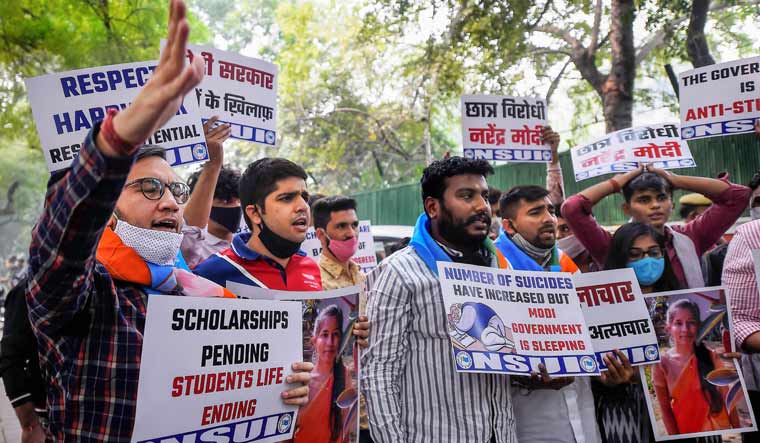
India, a nation that sought to be a ‘superpower’ by the year 2020, has failed yet another section of its population. Students, Researchers, and Scholars across the nation are struggling at the hands of a widening digital divide, an economic crisis, and to top it all, they are being denied their fellowships for months on end. Recently, a Telangana based college student from Lady Shri Ram College, Delhi University, was forced to take her life after being denied her scholarship funds for over a year.


Source – The Indian Express

The Department of Science and Technology awarded her the ‘INSPIRE’ scholarship after topping at her school. However, due to a crippling digital divide and the mounting financial inadequacies amidst the pandemic, she was rendered hopeless.


Source – The week

“The students’ union had surveyed the students to understand the impact of the digital divide. We found that she had no laptop, and it was difficult for her to attend the classes. The online classes cost her dearly for getting the data packs,” Unnimaya, General Secretary of Lady Shriram Ram College Students’ Union, and her friend had said in a statement.

It was later discovered that she was paying over 1 lakh rupees on her education. To add to her problems, she was asked to vacate her hostel due to the coronavirus pandemic, while transferring was not affordable.

UGC- JRF release and the untold stories

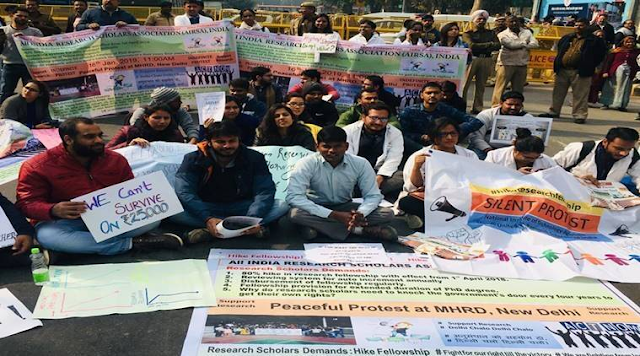
The suicide of the student has since triggered much controversy while throwing light on the crippling condition of quality education in India. Another campaign that has failed to make headlines but is equally significant is the #ReleaseUGCJRF campaign. Researchers entitled to their UGC JRF release have been denied their funds for several months now.


While UGC, the body responsible for the stipend’s discourse, has allegedly always been irregular, the situation worsened since the advent of the coronavirus pandemic. Junior Research Fellows have actively been writing letters and emails to get in touch with the concerned authorities but to no effect.

“UGC is the funding body for PUR monthly stipend. UGC has always been irregular in the disbursement of fellowship amount, but now the issue has touched another level altogether. They have not released PUR stipends since July 2020. Scholars from across the country have tried to reach UGC officials and various ministries associated with it via emails and phone calls, and we have not received any concrete responses yet,” A Ph.D. student from IIT Delhi who has not received her stipend since July said in a statement.

This is the case with several other fellows who are now struggling to make ends meet due to the pandemic. As a result, their reliance on their family members is spiraling.

“Since this pandemic started, they haven’t got any fellowships from any agents like UGC and CSIR. Students are asking their family members for money to pay for hostel mess fees, institution course fees, etc.,” a Ph.D. scholar from IIT Bhubaneswar cited.

“Due to this, at such ages as 24-25 years old, Ph.D. scholars are financially dependent upon families. This tends to depression, which leads to suicide,” he added.

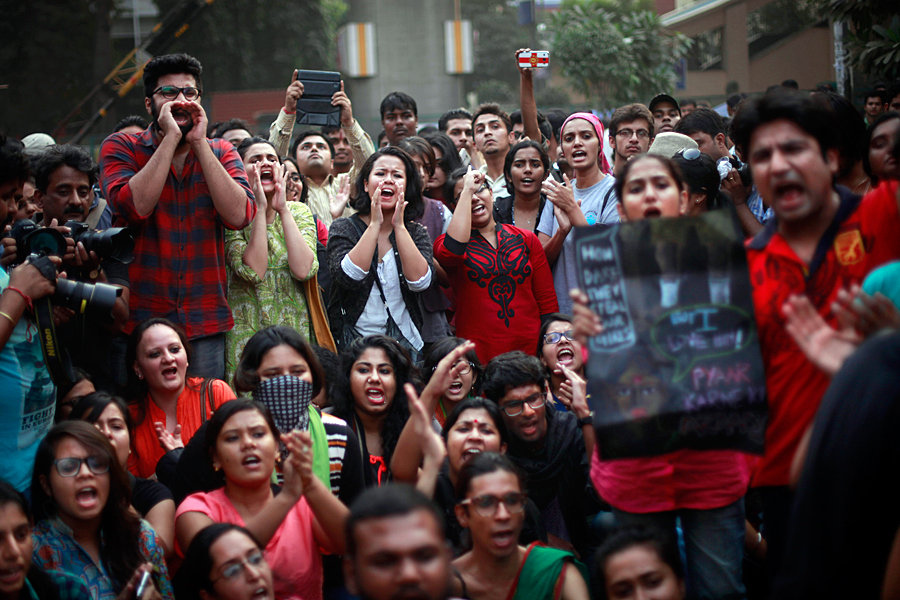
These students have come forward with everything in their power to get access to something they are entitled to have. From signing petitions to mailing in groups to digital protests, but their voices have gone unheard.

Delays and Demands

The delay in the release has also disrupted the research work of such scholars.

“This delay in releasing the fellowship amount is causing financial distress among us, and our research is suffering. I mean, who can think of research when they don’t have money to survive, especially during this difficult pandemic situation,” the researcher from IIT Delhi had said in a statement. On being asked about her demands, she emphasized the uncompromising need to release the JRF stipend with immediate effect.

“Placing a proper mechanism for timely disbursement of the fellowship and total transparency of the procedure” were among her other demands.

Another scholar pursuing his Ph.D. from IIT Delhi was greatly “disappointed” by the magnitude of problems he has been introduced to after having strived enough to get into eminent institutions such as the IIT Delhi. Due to the ongoing challenges, he informed Sambad that he has decided to resign from his current program to continue his research in the states hoping that it will be just.

A Ray of Hope

Without surprise, the UGC has been slapped awake by the LSR student suicide case. According to the latest updates, the University grants commission (UGC) on Monday declared that the pending fellowships for Junior Research Fellows (JRF) and Senior Research Fellows (SRF) would be released within a week.

In-charge of the INSPIRE Programme, Dr. Sanjay Mishra blamed the delay on “financial and technical” constraints during the pandemic.

Whether or not every student gets what they deserve, stories such as these make us question the legitimacy of our “developing” nation.

Monday, November 9, 2020

Neither is suicide a crime, nor can one be driven to it


Neither is suicide a crime, nor can one be driven to it

November 8, 2020, 6:35 AM IST 
SA Aiyar in Swaminomics | India, politics | TOI

Shashi Tharoor, Rhea Chakraborty and now Arnab Goswami. The social and electronic media are baying for their blood, accusing them of driving somebody — wife, lover, and creditor respectively — to suicide. As argued in earlier columns, this is moral and logical nonsense.

Historically, suicide has been a crime in almost all countries. Wikipedia lists hundreds of famous persons globally who died of suicide in the 21st century. Recent examples include actor Robin Williams, financier Jeff Epstein and chef Anthony Bourdain. The reason is almost always mental stress for some reason.

Since suicide is a crime, so is abetment to suicide. The word “abet” means “assist.” If a doctor assists a patient’s suicide, that is abetment. But in India hardly anybody is arrested for that. Rather, the police and courts interpret “abetment to suicide” to mean “driving to suicide”. I know of no other country where this happens. In none of the famous suicides globally have lovers or creditors been accused of abetting suicide.

I personally know many people — including my younger brother Mukundan and others in school and college — who died of suicide. They were tormented by life’s challenges and unfairness, fought with inner demons, and succumbed to stress that others could cope with. They were victims, not criminals. Many state governments give compensation to the families of farmers who commit suicide (as highlighted in the film Peepli Live). So, why don’t they decriminalise suicide?

“Driving to suicide” is a commonplace phrase but lacking in medical rigour or legal soundness. Thousands of students die of suicide every year after bad exam results. Should parents (who put pressure on their children) and teachers (who set exam papers) be accused of driving the students to suicide?

Many debtors who cannot repay bank loans kill themselves. Should all bankers who lent them money be jailed for driving them to suicide? If so, why should bankers risk lending money at all?

Every year, court judgments inflict terrible blows on those who lose, and some resort to suicide. A prominent recent example was Kalikho Phul, former chief minister of Arunachal Pradesh. He was ousted by the Supreme Court for coming to power through illegal political manipulation. Deeply humiliated, he resorted to suicide. Should the Supreme Court be prosecuted for driving him to suicide? No, that would be nonsense in all the examples discussed above.

My earlier columns have repeatedly pointed out that the suicide rate in India, and indeed globally, is around 11 per lakh people, or 0.01%. This can rise tenfold to 0.1% in great stress-causing disasters, but even so 99.9% of people remain suicide-proof. The rate is the same in rich USA and poor India. India’s suicide rate in highest in Puducherry and Kerala, but low in Bihar and UP, not because harassment and deprivation are greater in the south, but because cultural attitudes to suicide and mental stress are different. A study by Anuradha Bose in The Lancet found that the suicide rate among Tamil girls aged 15-19 years was 146/lakh — ten times the global average.

Through history, millions died in droughts and epidemics. Even so 99.9% did not commit suicide, since the desire to live overwhelmed the worst deprivations for all but a tiny suicide-prone minority. Millions preferred to die horribly rather than kill themselves in the Bengal famine or genocides of Hitler and Stalin. They had far more cause to resort to suicide than Sushant Singh Rajput or the creditors of Arnab Goswami but did not.

Overwhelmingly, unfortunates kill themselves because they belong to the 0.01% that are suicide prone. They cannot stand the stress of quarrels with spouses and relatives, unfair treatment, or failures in love, business, and exams. They are victims of mental ill-health. India’s recent Mental Health Care Act does not formally decriminalise suicide. But it says those attempting suicide will be presumed to be victims of mental ill-health, and hence protected from criminal prosecution. That is a welcome step. However, if suicide is in effect presumed to be legal, how can abetment to such a legal act be prosecuted as illegal, as the police are doing in the cases of Tharoor and Goswami? In both cases, the main reason for prosecution appears to be political vendetta. My liberal friends say Goswami constantly incites communal hate in his TV show, and was relentless in his campaigns against Tharoor and Chakraborty. If so, let him be prosecuted for inciting hate, not the trumped-up charge of abetting suicide.

In sum, suicide is not a crime, and you cannot be driven to it. The Supreme Court needs to proclaim that the notion of driving people to suicide is medically and logically ill-founded, and anyway must not be confused with abetment.

DISCLAIMER : Views expressed above are the author's own.

No progress in CBI probe into Fathima’s death, say parents - The Hindu


KERALA

No progress in CBI probe into Fathima’s death, say parents

STAFF REPORTER
KOLLAM, NOVEMBER 08, 2020 19:22 IST

Say CBI officials had called them a couple of times, but yet to take statement

Despite the Central Bureau of Investigation (CBI) taking over the probe, there has been no progress in the case related to the death of Fathima Latheef, a 19-year-old student who was found dead in her hostel room at the Indian Institute of Technology (IIT) Madras, her parents have alleged.

The Klappana resident, a very bright student and a rank-holder, was a first-year student of Humanities when she reportedly ended her life on November 9, 2019. Her family had filed a complaint after retrieving a note from her phone, according to which she was facing harassment from some faculty members, forcing her to take the extreme step. She had joined IIT in July 2019 and was the class topper when she died. “CBI officials had called us a couple of times during the last months, but they are yet to take our statement. I have sent a mail to the CBI director sharing our grievances and I want to believe that my daughter will get justice,” said Latheef, Fathima’s father.

The case was transferred to the CBI when her family and a delegation of MPs visited Union Home Minister Amit Shah and handed over a memorandum signed by 41 MPs seeking a fair probe.

Her family had raised several allegations after the death as the screensaver of her phone and notes saved in it had named the persons responsible for her death. But with the Kotturpuram police insisting that they could not find any suicide note, her father had alleged that Tamil Nadu police was trying to botch up the investigation.

Initial assumption

The initial assumption of the police was that Fathima committed suicide since she could not score good marks in the first semester examination. But according to her family, she had scored the highest marks in her class even in her last examination. They had also alleged that IIT authorities had prevented other students from talking to Fathima’s family and suspended the classes of her batch immediately after the incident.

Meanwhile, Kollam MP N.K. Premachandran has written to the Union Home Minister demanding a time-bound investigation. “The probe should be expedited as there is no breakthrough even one year after Fathima’s death. The CBI authorities also failed to respond to her father’s appeals and immediate steps should be taken to complete the probe,” he said.

Mr. Premachandran also observed that the mysterious deaths of students at IITs were a matter of major concern. “The reason for the increasing number of such incidents is the failure in finding and punishing the culprits,” he said.

Wednesday, October 21, 2020

SC imposes Rs 10K cost on lawyer over PIL on IIT suicides, terms it ‘frivolous’


SC imposes Rs 10K cost on lawyer over PIL on IIT suicides, terms it ‘frivolous’

SC imposed Rs 10,000 cost on a petitioner who filed PIL seeking direction to the Centre and IITs to formulate and implement a programme to address the menace of rising suicide cases on their campuses
Supreme Court of India


IANSPublished: 24 Sep 2020, 4:30 PM

Terming it "frivolous", the Supreme Court on Thursday imposed Rs 10,000 cost on a petitioner who filed a PIL seeking direction to the Centre and IITs to formulate and implement a programme to address the menace of rising suicide cases on their campuses.

A bench comprising Justices R.F. Nariman, Navin Sinha and Indira Banerjee said this is an utterly frivolous petition and asked the petitioner-in-person Gaurav Kumar Bansal: "How much cost should we impose on you?"

The bench noted that the Centre is well aware of the situation and dismissed the plea raising the issues of suicides on IIT campuses across the country.

During a brief hearing on the matter, Bansal argued that nearly 50 students have died by suicide in the IITs in the last five years. He urged the top court to intervene in the matter and also directed the Education Ministry and the IITs to formulate and implement a "student wellness programme" but the bench said it is not inclined to entertain the plea.

The lawyer submitted that a committee was earlier formed to probe into the causes behind suicide by students, and insisted that the situation remains the same.

Citing the Centre's response on the matter, the court told the petitioner that authorities were alive to the matter.

"We are dismissing it with Rs 10,000 as cost payable to the legal services authority," said the bench.

The plea had urged the apex court to direct all IITs to immediately plan, design, formulate and effectively implement a student health wellness programme. And, this programme should focus on prevention and reduction of suicides within the institutes, the plea sought.

Tuesday, October 6, 2020

Suicide is a bigger concern than murder,

Suicide is a bigger concern than murder
Prasoon Joshi on Sushant Singh Rajput’s case: 

Prasoon Joshi states during his interview that suicide is a disease, that also points towards the fact that someone is not able to cope and that something is not right in the Bollywood industry.

Written By Pinkvilla Desk 535239 reads Mumbai Updated: October 4, 2020 06:54 pm

Prasoon Joshi on Sushant Singh Rajput’s case: Suicide is a bigger concern than murder


Trigger Warning

The CBFC Chairman Prasoon Joshi spoke to Times Now for an interview. The ace screenwriter and poet states that it is very crucial to have concern. He further goes on to add that suicide is a bigger concern than murder. Prasoon Joshi states that how in a case of murder one has a culprit who the authorities will punish. But, CBFC Chairman states during his interview that suicide is a disease which brings to light how someone is not able to cope and how something is not right in the industry along with a feeling of insecurity among the people of the Bollywood industry.

He also states that previously he campaigned against suicides in the country. During the interview, the CBFC Chairman Prasoon Joshi was quizzed how the film industry got divided among people who supported Rhea Chakraborty and those who backed the late actor Sushant Singh Rajput. The NCB has arrested actress Rhea Chakraborty is Sushant's case. Prasoon Joshi also says that it is not just about producing blockbuster hits in the industry but also about the well being of its people. Prasoon Joshi was also quizzed about the drugs probe in Bollywood and questioned how it could be vendetta.

Prasoon Joshi says that the real issues get sidelined. He adds that if someone does not like his tone and manner of speaking nobody will pay attention to what he is saying. Prasoon Joshi says that where is the concept of having a dialogue with the people gone. Prasoon Joshi also mentions that instead of blaming each other, we must table the correct issues.

If you need support or know someone who is struggling, please reach out to your nearest mental health specialist or speak to someone about it. There are several helplines available for the same.

(ALSO READ: Kangana Ranaut is telling her truth, shouldn't be trivialised says CBFC Chairman Prasoon Joshi amid drug probe)

Sunday, October 4, 2020

At least 36 people kill themselves in Tamil Nadu every day, shows NCRB data


At least 36 people kill themselves in Tamil Nadu every day, shows NCRB data


According to the data, 50 percent of suicides in the state are related to family problems followed by illness which accounts for 18 percent of suicides

Published: 03rd October 2020 07:14 PM |


A total of 13,493 people killed themselves in 2019 in Tamil Nadu, giving it a 9.7% share (Express Illustrations)
By Sahaya Novinston Lobo
Express News Service

CHENNAI: For the fourth consecutive year, Tamil Nadu holds the second place in the number of suicides in the country, according to the National Crime Record Bureau (NCRB), with at least 36 people taking the extreme decision every day in the state.

A total of 13,493 people killed themselves in 2019 in Tamil Nadu, giving it a 9.7% share. Topping the list is Maharashtra with 18,916 and in third place is West Bengal with 12,665.

In October last year, seven from a same family killed themselves in Avadi and a month later, Fathima Latheef, a young college student from IIT-Madras, killed herself allegedly due to discrimination from the faculty. In the month of February, a 26-year-old Armed Reserve constable shot himself dead while on duty.

Tamil Nadu ranks first in family suicides in the country, with 43 people having died in 16 different cases. Similarly, over 914 students have taken the extreme decision in the state making it third in student suicides. Tamil Nadu also ranks first in suicides by government staff with 200 people in 2019.

According to NCRB data, 50 percent of suicides in the state are related to family problems followed by illness which accounts for 18 percent of suicides.

The data also mentions that girls below the age of 18 are vulnerable and kill themselves more than boys, while more men between the age of 30-45 take the extreme decision.

In the state, Chennai has more suicides with 2461 cases, followed by Madurai (345), Coimbatore (338) and Tiruchirapalli (188).

(Assistance for those having suicidal thoughts is available on Tamil Nadu’s health helpline 104 and Sneha’s suicide prevention helpline 044-24640050)

    Sunday, September 27, 2020

    People must learn to read early signs showing suicidal tendency or turn to experts - National Herald


    People must learn to read early signs showing suicidal tendency or turn to experts

    Suffering in silence is not heroic. But both individuals and families opt to keep quiet about a debilitating disease, a psychological disorder that seem to drive people to commit suicide

    Published: 20 Sep 2020, 1:00 PM

    It is hard to tell why some people end their lives while others in similar positions don’t. But the fact is that the world is witnessing an alarming rise in suicides, especially after the pandemic-induced lockdown. And the stigma is such that very few even now are coming out in the open and consulting professional counsellors and psychologists.

    Suffering in silence is not heroic. But both individuals and families opt to keep quiet about a debilitating disease, a psychological disorder, frayed nerves and despair that seem to drive people to commit suicide. If families, friends and neighbours cannot do the counselling, the professionals must.

    Persistent depression and feeling low, feelings of guilt and hopelessness, anxiety and panic attacks are some of the early signs that point to suicidal inclinations. There are days when things look really bleak. Setbacks in career and exams or relationships do make life look like a drudgery. But none of this should spell the end of the road.

    “I wish I were dead. I am unable to think properly. God, I need to control my sarcasm. I have a crushing feeling of inferiority… it seems like a mountain now, a mountain which I cannot climb,” blurts out Sahil (34), an IT professional. Prevailing uncertainties caused by the pandemic, pressure at the workplace and his wife threatening to sue for divorce have driven him up the wall.

    Dev is a teenager. A gangly 18-year old boy, he has been suffering from depression since before the lockdown. “I need to face things that medicines will not fix. Am I just a whining brat? I constantly feel guilty for being unable to change.” He had contemplated committing suicide but couldn’t bring himself to do it. “I am a pathetic coward. I don’t know if I will ever become strong enough…” he wails.

    Sameera’s is also a familiar story. An IIT aspirant because of parental pressure, she failed to clear the JEE. “Why didn’t I kill myself ? Why did I choose to live? My interests are dead. My motivation is dead. My imagination is dead. I am dead on the inside. And I feel like I am wasting your time because nobody can help me.”

    The good news is that all three ‘cases’ benefitted from counselling and therapy and are recovering.

    (The author is a Clinical Psychologist and Director, Optimus Center of Well Being, Gurgaon)

    Friday, September 25, 2020


    Legal Gallery: Supreme Court notice to UPSC, Centre on postponement of exams

    By PTI

    This seven hours long Offline exam, will be taken by approximately six lakh aspirants at test centres in 72 cities across the country


    New Delhi: The SC Thursday sought response from the Centre and the Union Public Service Commission on a plea seeking postponement of civil services 2020 examinations in view of alarming spurt of COVID-19 and floods.

    A bench of Justices AM Khanwilkar and Sanjiv Khanna issued notices to UPSC, Centre and posted the matter for hearing on September 28, 2020. The petitioners have sought postponement of the Civil Services Exam for two to three months, so that the flood/incessant rains go away and COVID-19 curve flattens.

    The plea, filed by Vasireddy Govardhana Sai Prakash and others, submitted that the decision of UPSC to conduct the exam in accordance with the Revised Calendar, violates the rights of the petitioners and those similarly situated, under Article 19 (1) (g) of the Constitution to practice their chosen profession/occupation of serving the public.

    The plea has been filed by 20 UPSC aspirants through advocate Alakh Alok Srivastava against conducting of the Civil Services (Preliminary) Examination on October 4. According to the plea, this seven hours long Offline exam, will be taken by approximately six lakh aspirants at test centres in 72 cities across the country.

    "Conducting the aforesaid examination across India at such perilous time, is nothing else but putting lives of lakhs of young students (including Petitioners herein) at utmost risk and danger of disease and death. Also, the natural calamities like flood, incessant rain, landslides etc. are likely to directly affect the life and health of the Petitioners and many similarly situated students. "Hence, the impugned Revised Calendar is utterly arbitrary, unreasonable, whimsical and patently violative of the "Right to Health" and "Right to Life" of the Petitioners herein and lakhs of similarly situated students, under Article 21," the petition stated.

    The plea said the Civil Services Exam, being a recruitment examination, is altogether different from an academic examination and in the event of its postponement, there would not be any question of delay or loss of any academic session.

    It said that due to non-availability of exam centres in their hometowns, many aspirants are facing "unimaginable" hardship due to non-availability of or unsafe health conditions in, the PG accommodation/ hostels/ hotels etc., where they are forced to stay with their family members, once they are travelling to an outstation Examination Centre. "It is pertinent to mention here that despite alarming spurt in COVID-19 pandemic, UPSC did not increase the number of Examination Centres, resulting into a situation where many candidates from rural areas will be forced to travel for around 300-400 Kilometres, in order to reach to their Examination Centres and there will be high probability of such aspirants, getting affected while using public transportation for such travel," the plea said.

    Quick look

    SC dumps PIL on suicides in IITs: The Supreme Court on Thursday dismissed with cost a PIL on prevention of suicides in the various Indian Institute of Technology (IIT) across the country. A Bench headed by Justice Rohinton F Nariman dismissed the plea terming it "utterly frivolous" and imposed a cost of Rs 10,000.

    SC calls plea seeking intervention of court in IIT students suicides 'frivolous', imposes 10k cost on petitioner


    SC calls plea seeking intervention of court in IIT students suicides 'frivolous', imposes 10k cost on petitioner

    During the hearing, Bansal submitted that in the last five years, about 50 students have died by suicide. The plea sought the court's intervention and sought a direction to direct the Centre

    Edex Live
    Edex Live


    Representative Image

    The Supreme Court on Thursday dismissed with cost a PIL on prevention of suicides in the various Indian Institute of Technology (IIT) across the country. A Bench headed by Justice Rohinton F Nariman dismissed the plea terming it "utterly frivolous" and imposed a cost of Rs 10,000. The Bench said authorities, as evident from the petition, are alive to the situation. "The PIL is utterly frivolous and dismissed with cost of Rs 10,000," it ordered.

    The PIL filed by advocate Gaurav Kumar Bansal has said that there was increasing number of suicides in IITs and sought the implementation of Section 29 of the Mental Healthcare Act. As per Section 29, Section 30 and Section 115 of Mental Healthcare Act, 2017, it is the fundamental duty of government and IITs to probe the cause of the rise of suicides in IITs campus and to plan, formulate and implement student health wellness programs in such a manner that the same shall reduce and prevent the suicide cases within their jurisdiction, the plea said.

    During the hearing, Bansal submitted that in the last five years, about 50 students have died by suicide. The plea sought the court's intervention and sought a direction to direct the Centre, AIIMS and IITs to formulate and implement the "students wellness program". "Formulate and effectively implement student health wellness program focusing on prevention and reduction of suicides within their institutions as provided under Section 29 and Section 115 of the Mental Healthcare Act - 2017. Direct government, AIIMS, and IITs for providing aid, support, and advice to persons with suicidal thoughts through Call Centers / Helplines at Institute level," the plea said. The data gathered by the petitioner through RTI and through other means clearly shows that respondents have failed to consider the issue of rise in suicides in IITs and AIIMS-Delhi through health prospects, it added.

    Tuesday, September 22, 2020

    Why 'Politicising' NEET Isn't the Problem We Should Be Focused on - The Wire


    Why 'Politicising' NEET Isn't the Problem We Should Be Focused on


    Protests from Tamil Nadu on the medical entrance exam have a lot to teach us about how governance should work.


    A NEET centre in Chennai, Tamil Nadu. Photo: PTI

    Yazhini P.M.

    EDUCATIONGOVERNMENTHEALTH
    8 HOURS AGO

    “I am sorry, I am tired.” These are words from the suicide note written by M. Jothisri Durga, a 19-year-old NEET aspirant from Madurai who died on September 12 2020, for whom this NEET exam would have been the second attempt.

    The same day also saw two other deaths by suicide – 20-year-old M. Adithya from Dharmapuri and 21-year-old M. Mothilal from Thiruchengode, both of whom were to attempt the NEET for the third time. On September 9, 2020, V. Vignesh, another 19-year-old aspirant from Ariyalur ended his life by jumping into a well. He too was set to attempt the NEET for the third time.

    Going by the words of the Tamil Nadu chief minister, as of September 15, 2020, 13 students have taken their lives due to NEET exams. Further, on September 12, 2020, DMK chief and leader of opposition in Tamil Nadu, M.K. Stalin promised to abolish the NEET and revert to using higher secondary exam marks for admissions to medical colleges in Tamil Nadu. He also said that a suitable redressal would be effectuated for those aggrieved.

    These promises were in line with all other regional parties and regional outfits of national parties, thereby signposting the essence of the Dravidian movement in the state of Tamil Nadu which sought to lower the entry barrier for students to enter professional courses through various mechanisms, including rationalising the reservation system, providing extra marks for first generation graduates, instituting quotas for rural candidates and the recent move by the present government to institute 7.5% seats for students from government schools.

    While the focus of sustained anti-NEET protests centred in Tamil Nadu, an outcome of the suicide of S. Anitha, a NEET aspirant from Ariyalur who had scored 1,176 out of 1,200 in the state board’s higher secondary examination but failed the NEET, gives a perception that student suicides linked to NEET is endemic to Tamil Nadu. The phenomenon is rather pan-India, with numerous suicides every year happening in the coaching hubs for NEET and JEE like Kota in Rajasthan, Telangana, Kerala and Andhra Pradesh.

    The deaths reported as student suicides in Kota, for example, are 16 cases in 2015, 17 cases in 2016, seven cases in 2017 and 19 cases in 2018. The situation is far more serious in Telangana and Andhra Pradesh, where in the year 2017, nearly 50 deaths were reported in the span of two months. While scores of deaths in these states doesn’t seem to evoke broad-based protests, Tamil Nadu reacts differently.

    Also read: Exams and the Pandemic: Who Is Afraid of ‘Losing a Year’ of Education?

    Conventional logic informs us that competitive exams revolve around the coaching class ecosystem which have grown around JEE and NEET. The high costs imposed on aspirants in turn skews their composition in terms of class, caste and gender. The question of representativeness of the successful aspirants is a cause of concern and strikes at the heart of the politics of aspiration and social justice prevalent in Tamil Nadu, especially given the lack of empirical evidence that this policy needed to replace the existing framework.

    Tamil Nadu saw branches of every key coaching institute opening shop in major cities in the wake of the compulsory implementation of NEET in 2016, when the BJP-led NDA government at the Centre passed the Indian Medical Council (Amendment) Bill. Prior to 2016, although NEET was in existence, freedom was provided for the states to opt out. Tamil Nadu had opted out.

    The economics of NEET and the Kota system of dummy schools

    The economics of NEET coaching classes is staggering, with the cost to a student in Kota, for example, amounting to at least Rs 5 lakh for higher secondary education and entrance coaching classes. The excessive focus on the entrance examinations is afforded at the cost of neglecting school education, through a system called ‘dummy school’, a disturbing outcome of the Kota system.

    This enables an aspirant to register nominally in a school paying full fees wherein the attendance is taken care of, while they slog in the coaching institutes. The nexus between the coaching class institutes and the dummy schools is an open secret. With the mushrooming of coaching class institutes across India, the Kota system of ‘dummy schools’ is making its way into states like Punjab and Andhra Pradesh. The curious case of NEET 2018 topper Kalpana Kumari throws light on this dynamic – she prepared for NEET from Aakash Institute in Delhi as a regular student while having registered as a student of YKJM College at Sheohar, Bihar.

    In addition to the financial burden on the aspirant, the increasing number of repeaters in the entrance examination system also decreases the possibility of first-time aspirants clearing the examination. Added to this is the toxic combination of high expectations from the family, peer pressure and pressure tactics from coaching centres. The students from socially and educationally disadvantaged groups – the OBC, SC and ST – face the added problem of the lack of role models, as many a times they are first generation higher education aspirants. In fact, it is the anticipated high cost of entry to coaching classes which self selects the class and in turn the caste and gender of the aspirants.

    Lessons from the past

    The reasons identified by Dr M. Anandhakrishnan, who headed the committee that led to the abolition of Common Entrance Test in Tamil Nadu in 2006, are worth problematising. In addition to the CET, Tamil Nadu had a system called improvement examination, which was introduced with the intention of helping genuine cases in which students fail to score good marks in their first attempt.

    CET and improvement exams exacerbating the urban-rural divide and their sharp bias in favour of students who could afford the time and money were identified and cited as reasons to abolish the same in order to provide a level playing field. This move has to be seen from the perspective of the recent move by the University of California’s decision to stop requiring standardised tests (SAT and ACT) on the grounds that these tests are inherently biased in favour of affluent, White and Asian-American students.

    Also read: NEET and Suriya: Freedom To Demur Is Not Contempt

    Examples from IITs reveal the systemic issues surrounding the selection mechanism wherein women formed only 8% of the total students enrolled in IITs for the year 2016. OBC representations in IITs improved only after the implementation of constitutionally mandated 27% reservation for OBCs.

    Resistance from Tamil Nadu

    With the rationale for anti-NEET protests based in Tamil Nadu resting on the worldwide phenomenon of moving away from standardised tests which have high entry barriers, there is a certain unanimity among parties in Tamil Nadu with the exception of BJP and Puthiya Thamizhagam against NEET. Incidentally, questions are now raised regarding who is responsible for NEET examinations, with AIADMK and BJP claiming that it was DMK and Congress who are responsible.On the other hand, AIADMK (which claims to enjoy proximity to the BJP) was questioned by the Madras high court as to why it kept the state and the legislative assembly in the dark for almost two years about the president rejecting two NEET Bills in September 2017, which were passed unanimously in the Tamil Nadu Legislative Assembly.

    Notably, such a development was revealed only when the Centre filed an affidavit in response to a PIL petition filed by Tamil Nadu Students Parents Welfare. The affidavit later filed by the Centre with a detailed sequence of events related to the bills revealed that there was no response from the Centre for the 11 letters sent by the state government between 2017 and 2019 seeking reasons for withholding the assent.

    Return to the past as the world strides forward

    While the Centre remains mum on the reason for withholding the assent, questions related to the inherent biases of NEET remain unaddressed. When the world is moving towards providing a level playing field for the student community, India is forcefully persuading the states to enter into a well chartered territory of standardised examinations, with inherent biases to skew the class and caste composition of the selected cohort. Notably, even with the intervention by the government to increase women’s representation in IITs via creating supernumerary seats, the bias regarding affording coaching classes to achieve access is not eliminated.

    Here lies the reason why issues around NEET are politicised along the lines of state autonomy in decision making and the concerns of the aspirational public, given that decision making by any government in relation to sectors like education is inherently political.

    With a clamour for silencing voices against NEET, in the name of maintaining an apolitical public sphere in matters of education, a great deal of disservice is rendered to the student community and by extension, society. Those in power must listen to those on ground, and voices from below should inform policymaking.

    Dr Yazhini P.M. is a registered medical practitioner from Government Theni Medical College and is currently based in Chennai. She tweets @yazhini_pm.

    Friday, September 18, 2020

    Is it Fair to Conduct JEE & NEET Amid Pandemic ? - QUINT,


    Fair to Hold JEE Main & NEET UG Amid Pandemic? Students Debate

    The Quint spoke to students who argued for and against JEE Main & NEET in September 2020.

    Published: 
    EDUCATION
    2 min read

    Video Editor: Ashutosh Bhardwaj


    From contactless frisking to COVID declarations from aspirants to just 50 percent utilisation of test centres, the National Testing Agency is on a war-footing to conduct JEE Main and NEET UG 2020 in September 2020.

    But are the students ready? Why is such a large section of aspirants opposing the exams in September? And what are the merits of conducting the entrances at the earliest?

    In order to evaluate both the sides of the coin, The Quint spoke to JEE aspirant Aniket Mishra, who wants exams to be conducted in September, and to NEET aspirant Arushi Sarangi, who’s been very vocal for the need to postpone the exams.

    Is it safe to conduct exams in September 2020?

    Arushi Sarangi, NEET aspirant: “We have been given separate slots for entering the exam hall to avoid crowding. But there is no such slot for leaving the exam hall. Which means we can all imagine the crowd that'll be there. Also, there are so many exam centres. What is the guarantee that in each of these exam centres these measures will be followed?”

    Aniket Mishra, JEE aspirant: “Those who want exams to be postponed can they give it in written that the situation of COVID-19 in November and December would be better? The SOPs are made by the NTA but the implementation has to be done by students. If the students don't implement them, what can the NTA do?

    Won’t postponing exams delay the academic session?


    Aniket Mishra, JEE aspirant: “We have already lost one semester, remember, one semester. If we conduct exams in November and December, maybe the full academic year will go to waste.”

    Arushi Sarangi, NEET aspirant: “The ex-director of AIIMS and the Director of IIT Delhi have both claimed that they can adjust the academic calendar and it's very much possible by cutting down holidays and probably taking extra classes too.”

    What about the students who can’t take the exams?


    Aniket Mishra, JEE aspirant: “Due to floods or any transportation issue if students can't reach the exam centre, the authority should plan a special exam and the admission process should be special.”

    Arushi Sarangi, NEET Aspirant: “If the exams take place in September, it will be a huge mass injustice to students and their families too. For many people, it is their last attempt and it is not their fault that they would be missing the exam either because they have the COVID-19 infection or because of fear.”

    Watch the video above for the full debate.

    The Quint is available on Telegram & WhatsApp too, click to join.

    The bereaved need therapy, not compensation


    The bereaved need therapy, not compensation
    Source :SIFY
    Author :SIFY
    Last Updated: Wed, Sep 16th, 2020, 10:29:08hrs


    Political parties are used to viewing every unnatural death as an opportunity—the ruling parties in the state get leverage with the centre, the opposition parties have a new bullet point in their litany of complaints against the ruling party, the ones that don’t matter get to enjoy their fifteen minutes of fame by sending their leaders to meet bereaved families and make the right or wrong noises about competitive examinations and police brutality and government ineptitude.

    Journalists who have been crawling like maggots around the homes and workplaces of the dead will be glad to have something to report—the amount of compensation received from each party, the views of each political leader, the reactions of the disaster tourists joining the brood of maggots.

    Every time a student commits suicide, we blame the “system”. The National Eligibility and Entrance Test (NEET) has been a sore point with several states since its inception. Politicians claim, and the public agree, that the competitive exam imposes an unfair disadvantage on those who have not had an elite education. What is does for certain is take away a point on their manifestos—they can no longer make promises on behalf of medical education. It levels the playing field in theory, and eventually will in practice.

    But the problem is not competitive examinations. Every examination, even relatively unimportant ones, has been a trigger for student suicides. Students often leave behind letters saying they were afraid of the results—not simply because a low score would deprive them of further education, but because they were afraid of the reactions of their families, or were unable to live with the guilt of having been a financial burden on their families and not delivered on the investment.

    We will have to live with the fact that there needs to be a gauge for qualification for entry into colleges, and then another gauge for qualification for entry into employment, particularly when performing one’s duties involves being responsible for the health and even lives of others. Examinations have been one of these gauges. There are others too.

    An invisible gauge is one’s passion for the subject.

    How many students writing the NEET, or any other competitive exam such as the IIT-JEE, or the UPSC, have a passion for the course that their careers will take if they were to succeed in the examination? How many more take the examination for the sake of the honour and prestige and parental or societal approval and validation that those careers will guarantee?

    The villains are not the examinations. Among the three students who killed themselves in Tamil Nadu on the eve of the examinations, one had spoken of being afraid of letting her parents down and written several times that she could not handle the pressure; another had excelled in the mock examination.

    The villains are not the parents either.

    What kills people is the fear of betraying expectations, the shame of being a burden on their families.

    And when political parties compete to dole out compensation to the bereaved, they set a trend.

    Farmer suicides have been attributed not simply to the failure of monsoons, but the hope that they will be able to look after their families in death better than they could in life—whether life insurance pays off or not, the government and opposition compensation certainly will tide their families through the financial crisis.

    What the bereaved need is not a channel for blame. Screaming about the unfairness of NEET converts their guilt into anger, and allows them to blame an idea or person instead of blaming themselves. The media is happy to latch on to this. The Twitterati tweet.

    But in the privacy of their homes, away from the spotlight, knowing all the money in the world will not bring back their dear departed, the bereaved do feel guilt.

    In the case of other unnatural deaths—unrelated to examinations, but either suicide or homicide or the result of negligence too—the families are struggling with guilt and grief. It is bad enough when someone dies of natural causes—one wonders what one could have done that might have saved them. Knowing that the person would be alive if not for a moment of negligence or hatred or self-loathing or other transient cause is a permanent source of torment.

    It has always been my belief that all of us need some form of professional mental healthcare. Just as we have physical health check-ups every now and again, we ought to have our minds checked too.

    People who have been through trauma need this urgently. They need their ways out of the darkness. The idea of compensation was to make up for the loss of a breadwinner. However, at the rate at which it is being doled out by vested interests, “compensation” has begun to feel like blood money.

    If the government does care about its citizens, it cannot limit its aid to payouts.

    More Columns by Nandini Krishnan:

    Friday, September 11, 2020

    The Community Has a Critical Role in Suicide Prevention


    The Community Has a Critical Role in Suicide Prevention
    Published on September 10, 2020

    Mumbai : Suicide is a social issue and not an individual problem. An online discussion on “Suicide Prevention: The Importance of Community” hosted by YourDOST, India’s largest online counseling and emotional support platform designed to foster mental health, today appealed for more efforts from the community to raise suicide prevention awareness. The panel discussion was held to mark World Suicide Prevention Day.

    60-Second Quiz Reveals What Type Of Parent You Are

    The panelists included 
    Dr Seema Sharma, clinical psychologist; 
    Ms. Sandhya Menon, Independent writer, journalist and a suicide survivor; 
    Rajesh R Pillai, lawyer and President of Befrienders India; 
    and 
    Raashi Thakran, a certified QPR trainer, and a suicide loss survivor. 

    The discussion was moderated by 
    Dr. Jini K Gopinath, Clinical Psychologist and Chief Psychology Officer, YourDOST.

    India has been witnessing an increasing number of deaths by suicide. According to data compiled by the National Crime Records Bureau (NCRB), since 2007, there has been a 52% increase in the number of suicides among youth in India, with an average 26 suicides taking place every day, or one every hour. These grim figures are alarming enough for the society to bring about a fundamental change in its approach towards mental and emotional issues.

    Commenting on the community’s responsibility in the massive increase in suicide rates, Advocate Mr. Pillai said, “Community has a big role to play since not all suicides are due to mental illness but also due to apathy and lack of avenues to express oneself. Being able to share one’s grief and air their trauma is a basic need of a human being. A systematic change at every level to create a more supportive ecosystem is imperative – from family to teachers to Governments, everyone has a role to play in avoiding these instances.”
    Dr. Sharma said, “Suicides due to life events or psycho-social situations deserve much greater attention. Generally as a society we are not very supportive, rather judgmental especially when it is about mental wellness, personal choices, grief, and trauma. Any individual showing suicidal tendencies or contemplating a drastic step needs a listening ear and compassion. We should use available resources such as community elders, especially in rural areas where professional help is limited, who can give time, listen with empathy and without judgment.”

    Ms. Raashi, a YourDOST mental wellness champion who has been actively driving a campaign for the launch of a National Suicide Prevention Helpline lost her brother to suicide and eventually her own mental health deteriorated. She shared her life experience and issues with PTSD and anxiety, “Death does not happen to the person that dies. It also happens to the people left behind. I started struggling after my brother’s demise. Doctors helped me a lot, so did medication. But what really helped me was talking about it. I now know how important suicide prevention is and that led me to delve further into this. The data was scary. That prompted me to work towards prevention awareness”.
    Earlier this week, the Central Government launched a 24X7 toll free mental rehabilitation helpline (KIRAN) for providing psychological support to people.

    Ms. Sandhya, mental wellness writer and a survivor spoke about her own experience with suicidal attempts and triggers, “7 years ago, I was diagnosed with depression. I had a tough time being a single mother to two kids and increasing financial challenges. An argument with a family member triggered my first attempt. I felt not understood. I was expressing myself on social media instead of talking to my friends. I could never reach out and say I need help”.

    The session lasted for over 60 minutes and touched topics that are generally considered a taboo such as dysfunctional families, poor consideration towards mental health, non-judgmental acceptance and practicing empathy without criticism. The panelists answered the viewers’ questions before signing off.

    The panelists suggested a three-step actionable plan for suicide prevention:

    1.)Look: Look for warning signs which may be physical, verbal, or non-verbal 

    2.) Listen: Actively listen to the person, 

    and 3.) Link: Link those needing help with the various stakeholders/professionals/ volunteers.

    Concluding the session, 
    Dr. Gopinath, YourDOST said

    “Suicide is not just a psychological issue. It is a psycho-social issue. As a society, we miss the clues. We need to be mindful of signs from the psychological perspective. Listen actively and carefully. Link people in need with the experts and volunteers who can lend an empathetic ear”.

    About YourDOST:

    Headquartered in Bengaluru, YourDOST, is a leading start-up company that provides mental wellness services through an innovative technology platform. It anonymously connects people with the right expert consisting of Psychologists, Counselors, Career Guides for guidance related to anxiety, relationships, career, academics, sexual wellness, self-improvement and more. through completely confidential individual sessions. 

    Founded by Mr. Puneet Manuja, an IIM- Bangalore alumnus and Ms. Richa Singh, an IIT-Guwahati alumna in 2015, YourDOST has so far impacted over 2 million lives in India. They work with 100+ top corporates and colleges all over India and have also tied up with state and central government agencies for counseling support.