I have a Solution that will reduce pressure on IIT aspirants but do not know how to get this across to HRD Minister of India. Suggestions are welcome. - Ram Krishnaswamy

Search This Blog

Saturday, December 7, 2019


Saturday, December 07, 2019


Opinion » Comment

Posted at: Dec 6, 2019, 6:40 AM; 


Avijit Pathak

Fathima Latheef’s suicide points to the tragic story of our academic culture


We’ve failed: The site of higher learning is now a war zone. And there is no winner.

Avijit Pathak
Sociologist

When I came to know about Fathima Latheef’s suicide, I realised the pain of my wounded self. Because as a teacher engaging with hundreds of young minds like her, I experienced the tragic end of a possibility: a dream that inspired this bright, young girl from Kerala to come to IIT-Chennai and pursue higher education in philosophy and humanities.
It was a dream of self-exploration — a journey to the fascinating world of books, thoughts and ideas; it was a dream of psychic and social mobility. But then, it would be wrong to see Fathima’s story in isolation. As a teacher, I have no hesitation in saying that a suicide reveals many problematic layers of campus life and associated academic practices.

Fathima was bright; or, to put it otherwise, she was ‘topper’ material. Did she experience severe performance anxiety: the constant pressure to excel, and retain the ‘self’ of the topper? 
I see my own students — bright and dreamy like Fathima — living with terrible pressure. Quite often, in an aspirational society like ours, many of these students come to universities with a heavy baggage of societal expectations. From parents to neighbours to school principals, there seems to be only one lesson they have learned. They have to succeed. Success measured through grades is the assured road to social/economic mobility; and failure is a matter of shame. The site of higher learning has become a war zone, and there is no winner. In a way, everyone is a loser. If you fail, you are condemned and stigmatised. And if you win, you die — psychologically and spiritually — because of the pressure to retain the topper position. And even the slightest fall from that elevated position makes life miserable and meaningless. 

Is this the reason why in this hyper-competitive/performance-centric academic culture, psychic anxiety and acute loneliness affect the mental health of many young minds? Furthermore, in many of these centres of excellence, as teachers we put enormous pressure on our students. There is no catharsis, no joy, no celebration in academics. Tutorials, seminars, examinations, books and papers: with absolute mecahanisation and ritualisation, a young learner keeps consuming varieties of knowledge capsules. 

There is no breathing space; there is no possibility of calmness and mindfulness; there is no communion with the treasure of life — looking at the sky, and experiencing the beauty of idleness. We have transformed young minds into horses in a race. The knowledge they are compelled to acquire does not liberate them; it makes them incapable of meeting the challenges of life with grace and patience. This is the tragic story of our academic culture.

There is yet another factor that needs to be understood. For instance, Fathima’s suicide, as many reports disseminated through social media suggest, indicate the possibility of some sort of psychic/symbolic violence she might have experienced because of her identity, and a problematic relationship with some faculty members. Quite often, in a heterogeneous and highly stratified society like ours, filled with violence emanating from asymmetrical power relations, we hear diverse narratives of victimisation in the name of caste, gender, religion and ethnicity. It is a fairly complex domain, and in the name of finding some conspiracy, if we sensationalise the issue through instant judgement, we would not be able to go deeper. 

Many studies have revealed that there is no denying the fact that our educational centres do experience what happens in the larger society: the act of humiliating the marginalised and the minorities. Moreover, as teachers, we are not angels, and it may not be altogether impossible to find, say, male/‘forward caste’ teachers from the dominant community conveying the gestures and symbols that humiliate Dalits or the minorities. And for a vulnerable young mind that is at the receiving end, this violence might prove to be fatal. However, it is equally important to realise that the hyper-sensitivity to this social evil, as well as some sort of reductionist identity politics (implying the belief that never can one see beyond one’s caste or religion), have created a toxic culture of perpetual doubt and suspicion. As a result, we refuse to see that there are limits to stereotypes; and it becomes exceedingly difficult to believe that education is also about the flowering of human possibilities — something beyond one’s caste, gender and religion. And even in this ugly/violent world, there are people who have tried to come out of the arrogance of their privileged positions. But then, in an environment of doubt and chronic suspicion, it is taken for granted that a ‘forward caste’ teacher is bound to be casteist; and a male professor can never escape the psychology of patriarchal violence. This is also some sort of hyper-reaction causing severe damage to the process of creating a culture of trust, reciprocity and dialogue. No meaningful education is possible amid this broken/distorted communication, and perpetual apprehension about one’s motives. This is something that worries me as a teacher.

Every act of suicide reveals our collective failure. Particularly when we fail to prevent a young learner like Fathima from playing with death, as students, teachers and concerned citizens, we all ought to contemplate, and, instead of indulging in sensational politics, try to create a humane/stress-free/inclusive culture of learning that values the uniqueness of every student, and generates warmth and tenderness in interpersonal relationships. This effort would be the most meaningful tribute to Fathima.

Fathima Latheef suicide: PM Modi, Amit Shah promise CBI inquiry - Indian Express

Fathima Latheef suicide: PM Modi, Amit Shah promise CBI inquiry


The kin got the assurance at a personal meeting. A parallel probe into past such incidents in the higher edu sector too will be held

Published: 06th December 2019 06:29 AM | Last Updated: 06th December 2019 06:29 AM | A+A A-


Fathima Latheef was pursuing an integrated MA programme at IIT-M.
By Express News Service

NEW DELHI/KOLLAM: Prime Minister Narendra Modi and Home Minister Amit Shah have assured a group of MPs and the family that the CBI will investigate the recent suicide of Fathima Latheef, a student at the Indian Institute of Technology-Madras (IIT-M), according to her twin sister Aysha Latheef.

Speaking to TNIE, Aysha said the prime minister and union home minister have assured the family that a probe will be conducted into similar cases reported from higher education institutions including IITs and IIMs.

Fathima’s family met the prime minister and home minister in New Delhi along with MPs from Kerala on Thursday. “The prime minister has assured us that within a week, the case will be handed over to the CBI. Amit Shah also told us that two investigations will be ordered in parallel -- one related to Fathima’s death and another to reinvestigate all similar cases which have been reported from such higher education institutions including all IITs and IIMs till date,” she said.

N K Premachandran, MP and RSP leader, who was among the MPs who accompanied the family, said: “Both the prime minister and home minister have informed us that the suicide of IIT-Madras student Fathima will be investigated by CBI. The investigation will be led by an Inspector General-rank woman officer.” The RSP leader said the MPs met Modi and Shah along with Fathima Latheef’s father and sister who hail from Kollam. A memorandum seeking a CBI probe into the case was handed over to the prime minister and home minister by the MPs. “Congress leader Rahul Gandhi representing Wayanad constituency in the Lok Sabha is the first signatory in the memorandum,” Premachandran said.

The Crime Branch wing of Tamil Nadu police is now investigating the suicide of Fathima, a first-year Humanities student, on November 9.The incident had sparked protests in Chennai, with opposition parties including the Dravida Munnetra Kazagham, demanding a “transparent” investigation into the death.


‘Fathima named 10 persons’

Expressing doubts about his daughter’s death, Abdul Latheef, father of Fathima Latheef who was found dead in a hostel room at IIT-Madras, has demanded a fair probe to find out whether it was a suicide or a planned murder. He also revealed that Fathima has named 10 persons in her suicide note.

“As per the information provided by the police and her hostel mates, there were no signs of suicide in the hostel room from where her body was found hanging. Also, the names of 10 persons including three teachers and NRI students have been mentioned in her suicide note,” said Latheef.

He also said the other students also informed him that her body was found in a kneeling position and the room was not locked from inside. The family alleges that the visuals from the CCTV cameras at the hostel were later found tampered with. Earlier, he had alleged that some students from Kerala including NRI students and some seniors also had a major role in his daughter’s death. Meanwhile, after inspecting Fathima’s laptop and tablet, the forensic department has confirmed before a Chennai court that the suicide note was written by her.
KIN DOUBT VERSION
Abdul Latheef said the other students had told him Fathima’s body was found in a kneeling position and the room was not bolted from inside. The family claimed CCTV footage from the hostel had been found tampered

Death on IIT-M campus - Front Line


THE NATION
EDUCATION
CONTROVERSY

Death on IIT-M campus


ILANGOVAN RAJASEKARAN
Print edition : December 20, 2019T+ T-


IIT Madras students Azhar Moideen and Justin Joseph on a hunger strike seeking a fair probe into the death of Fathima Latheef, in Chennai on November 18. Photo: PTI


Fathima Latheef.

A student’s death on the IIT Madras campus again brings to the fore a serious structural malaise in the institute.
“My name itself is the problem, vappichi”—Fathima Latheef.
For Fathima Latheef, joining a prestigious educational institution like the Indian Institute of Technology (IIT) was a dream come true.

When the Muslim girl from Kollam in Kerala was admitted to the M.A. Humanities and Development Studies (Integrated) at IIT Madras, she was thrilled. Besides topping the entrance test in Humanities, she had obtained admission to Banaras Hindu University, Varanasi. But her mother was hesitant to send her to Varanasi since the newspapers were full of reports on “mob lynchings” in northern States. It was she who insisted on her daughter taking up the offer from IIT Madras.

But the dream turned into a nightmare in just four months. Fathima joined the institute on July 23, 2019. Her parents claimed that she had found the IIT campus environment stifling. She told her father, Abdul Latheef, who was working in Saudi Arabia, over a videoconferencing call two days prior to her suicide that her name gave away her Muslim identity, which her mother was apprehensive off.

“She told us that the campus was neither conducive to higher education nor congenial for those who hailed from disadvantaged backgrounds and broke down,” Abdul Latheef told the media. She again spoke to her father and mother on November 8. “We thought she was homesick,” said her twin sister, Aysha Latheef. From the evening that day, her mobile phone was switched off. On November 9, the 19-year-old first year student was reportedly found hanging from the ceiling of her hostel room. The police claimed that she could have committed suicide the previous night. The IIT management informed the family about her suicide around 11 a.m. on November 9. The Chennai City police (Kotturpuram) registered a case of unnatural death the same day and sent the body to the Royapettah Government Hospital for a post-mortem.

Fathima’s family members, who addressed the media frequently both in Kerala and Tamil Nadu after the suicide, claimed that her mobile phone, which was in the possession of the Chennai City police then, was switched on three days after her suicide. Aysha told the media that she saw the phone on a table at the police station and with police permission switched it on after charging it. She claimed that it did not ask for a password and a message instantly popped up on the home screen saying: “Sudarshan Padmanabhan [an associate professor] is the cause of my death. P.S. Check Samsung notes.”
Besides this, another message said: “I love you, umma and chakku. I love you, vappichi and thumbu. You are the only people in this entire world who have made me happy. I will always be with you. I have always loved you….” Both these messages were found to have been created and modified on November 8.

Fathima’s family was not satisfied with the way the Chennai City police handled the investigation. The police told the media that the girl had been depressed for two days prior to her suicide. They said that they had not obtained any suicide note from her room. The mobile phone they seized from Fathima’s room had remained untouched by the police and its battery was drained. Aysha had to recharge it to find out the suicide messages after three days.

There was talk inside the campus that the girl had committed suicide since she could not cope with the academic pressures, but Abdul Latheef refused to buy into such rumours. He wondered how his daughter, a topper in the all India entrance examinations and in the class, could commit suicide. Whenever a student committed suicide on its premises, the IIT management usually said it was a result of failure to cope with the academic pressure. “They harassed my daughter and virtually killed her,” he said.

Aysha said that Fathima was in constant touch with her, updating her with her academic travails. Although she was a class topper, she was given only 13 marks out of total 20 in the internal paper in Logic, which she strongly contested. On Fathima’s plea, Aysha said, the head of the department took up the case and assessed her internal performance. He found her claims to be true and accordingly instructed the associate professor concerned to award five more marks. Instead, the professor, Sudarshan Padmanabhan, asked her to meet him on November 11.

(Sudarshan Padmanabhan works at the Department of Humanities and Social Sciences as Associate Professor in Philosophy in which Fathima was a student. The professor, according to the institute website, is a special adviser to foreign students and chairman of the committee for monitoring general facilities for students. He was active off–campus and was involved with various forums that talk about electoral and political reforms. He was a regular participant in many programmes of the Chennai-based non- governmental organisation Arappor Iyakkam.)

“Something had transpired during this period, which would have hurt her self-esteem. The police should find out,” Abdul Latheef insisted. Aysha said that Fathima was a bold girl and would never worry about petty issues such as scoring low marks.

“She had been telling us that her name annoyed many on the IIT campus. But she was scared of something or somebody. It was eerie when we came to the IIT after hearing about her death. Everyone, even her classmates, preferred to keep away and avoided us. None came forward to share our grief. They are hiding something. It looked all weird,” she said.

When Frontline spoke to a few students on the issue, they refused to be named, fearing repercussions. Many who have left the campus too are unwilling to share their experiences on the campus.

Not satisfied with the Chennai City police’s probe, and believing that they will not get justice, the family met Kerala Chief Minister Pinarayi Vijayan and urged him to ensure a fair probe into the death. Abdul Latheef told Pinarayi Vijayan that his daughter had alleged that a senior professor had “harassed” her. On instructions from Pinarayi Vijayan, the family flew to Chennai and met Tamil Nadu Chief Minister Edappadi K. Palaniswami and asked him to order a fair investigation.

After the meeting, the case was transferred to the State’s Central Crime Branch (CCB) police, which began its investigation in right earnest. It held an inquiry with the professor concerned and others on the campus.

The family also claimed that Fathima had been subjected to “constant harassment” by the professor who was the “cause of her death”. They also met the Tamil Nadu Director General of Police and the Chennai City Police Commissioner.

In a media conference, Abdul Latheef said that he came to know that several brilliant students had committed suicide following harassment by professors and others in IIT, adding that all such incidents had been covered up by the IIT authorities using their political clout.

“We seriously feel that there will not be any fair investigation in this regard and the mobile phone of my daughter [he mentioned the mobile number] will be definitely tampered with under pressure from the IIT authorities to destroy evidence,” he said.

IIT statement

The IIT administration reacted after six days of the girl’s death with a short note of grief. In its statement, it said:

“The students, faculty, staff, and residents of IIT Madras are deeply saddened and extremely perturbed by the unfortunate and untimely demise of our student Ms. Fathima Latheef, and the events that unfolded thereafter. As soon as the incident came to the knowledge of the authorities, the police was informed immediately and are being extended full cooperation by the Institute. IIT Madras is committed to do whatever is required as per law and ensure fair play.

“However, the social media trolling of the Institute, faculty members and students and trial by the media, even before the conclusion of the police investigation, is gravely demoralising the students, faculty members and staff as well as their families, and tarnishing the reputation of one of the finest institutes in the country. Our faculty is known for its high quality, integrity and fairness.

“We continue to mourn the loss of such a promising young student and continue to take all efforts to ensure the physical and mental well-being of our students, faculty and staff. We reiterate that we are fully cooperating with the police investigation. Our humble appeal to all concerned is not to initiate or spread any rumours about the Institute and those involved and let the enquiry be completed.”
The statement was dated November 15. More than its expression of grief over the death, the letter laid stress on its deep concern over the trolling of the institute on social media.

There was no mention of any internal inquiry, nor was there any reference to any internal mechanism such as student counselling.

A highly competitive academic milieu exerts tremendous stress on students and faculty. Many institutions of higher education, both in India and overseas, have developed mechanisms to address this issue, but IIT Madras does not have one, according to students. They said there was a forum called Saathi, but it was ineffective in such extraordinary situations.

“They are more worried about their brand image and its marketing. They brushed aside suicides in the past too, putting the blame on the students, saying that they were not able to cope with the academic rigour. But the Fathima case is different. She was a class topper too. Not a single internal inquiry has been conducted on any suicide so far,” said an alumnus of IIT Madras who did not wish to be named.

Student protest


Two students named Azhar Moideen and Justin Joseph and a few others held a brief hunger strike under the banner of ChintaBar, a recognised students’ body in the institute, near the campus’ main entrance on November 18 and urged the IIT management to conduct a survey on the issues faced by the students. ChintaBar demanded an internal probe against the faculty as sought by Fathima’s family.
It called for “no more deaths in IIT”. The management held talks with the students and convinced them to withdraw the strike.

The students told The Hindu that they never faced discrimination on the basis of religion on campus nor were the professors mentioned by Fathima prejudiced, in their experience.

IIT-Madras student death: Father says Amit Shah has assured him of CBI probe _ The Hindu


IIT-Madras student death: Father says Amit Shah has assured him of CBI probe


NEW DELHI, DECEMBER 05, 2019 19:00 IST


Abdul Latheef, father of Fathima Latheef./ File photo

The father of a 19-year-old woman, who allegedly committed suicide at IIT-Madras, said he met Union Home Minster Amit Shah on Thursday and was told that the CBI will be asked to investigate the case.

The Tamil Nadu Police’s Crime Branch is probing the November 9 suicide case of Fathima Latheef, a resident of Kerala.

Abdul Latheef and his wife Sajitha met Mr. Shah on the Parliament’s premises on Thursday along with a delegation of MPs from Kerala.

Speaking to reporters, Abdul Latheef said Mr. Shah told him that the investigation would be conducted by a woman CBI officer of the inspector general level.

Kerala MP N.K. Premachandran, who led the delegation, claimed that the Home Minister also conveyed to them that the probe would look into the issue of mental harassment and pressure on students by IITs and other educational institutions.

Prime Minister Narendra Modi and Mr. Shah have assured the MPs that the CBI will investigate the suicide case, he said.

Fathima Latheef, a native of Kollam in Kerala, in her suicide note, blamed harassment by a professor of the institution as being reason for her death. The 19-year-old, who was pursuing her first-year under-graduation in humanities, allegedly committed suicide by hanging herself from a ceiling fan.

Immediately after his daughter’s death, Abdul Latheef had alleged in Chennai that he had evidence to prove that Fathima was being harassed by some professors in her department of Humanities and Social Sciences.

He wanted a fair probe as he was concerned that her phone may be tampered with. The family found Fathima’s suicide notes on her mobile phone.

Friday, December 6, 2019

Keralites too in Fathima death - Deccan Chronicle

NATION, CURRENT AFFAIRS

DECCAN CHRONICLE.
PublishedDec 5, 2019, 1:56 am IST

Latheef also said he would publish more evidence if the arrest of the accused is delayed indefinitely.


Fathima Latheef

Kollam: Some students from Kerala are also involved in the incidents that led to the suicide of Fathima Latheef, 19, at IIT Chennai last month.

Fathima Latheef’s father Abdul Latheef said, “her college mates, including NRI students and some seniors, have a major role in her death, apart from her teachers who mentally tortured her. There is strong evidence to prove the involvement of these students which will be produced before the court,” he said.

Latheef also said he would publish more evidence if the arrest of the accused is delayed indefinitely. Meanwhile, the forensic department, after inspecting the laptop and tablet PC used by Fathima, confirmed before the court that the suicide note was written by her prior to her suicide.

The family will also demand the Prime Min-ister’s intervention to appoint an independent agency to conduct the investigation. The central Crime Branch poli-ce team under Chennai City Police Commissio-ner A.K. Viswanathan had completed a preliminary investigation.

Fathima Latheef was found hanging from the ceiling of her hostel ‘Sarayu’ on November 9.

Chennai: HC reserves verdict on PIL for CBI probe into IIT-Madras student suicides - Indian Express


Chennai: HC reserves verdict on PIL for CBI probe into IIT-Madras student suicides

The PIL was filed by the Loktantrik Yuva Janata Dal on November 25.

Written by Shivani Ramakrishnan | Chennai | Updated: December 5, 2019 5:29:29 pm


XXThree students have killed themselves in IIT Madras this year. (File Photo: IIT-Madras)

The Madras High Court Tuesday reserved its verdict on a Public Interest Litigation (PIL) seeking CBI investigation into suicides at the Indian Institute of Technology, Madras (IIT-M).

The PIL was filed by the Loktantrik Yuva Janata Dal on November 25.

“In the last two years, there were five suicides at IIT Madras. The reason I had filed the PIL is because I want to stop student suicides at all IITs in the country,” Saleem Madavoor, the national president of Loktantrik Yuva Janata Dal (LYJD), who had filed the writ petition, told Indianexpress.com.

Also Read | 50 student suicides in 23 IITs in 5 years: Govt

Last year, IIT-M had been rocked by two suicides as Shahal Kormath from Kerala took his life in September, followed by assistant professor Aditi Simha’s suicide in December. This year, the institute had begun its year on a bleak note after Gopal Babu, a native of Uttar Pradesh and Ranjana Kumari, a resident of Jharkhand, committed suicide in January, followed by Fathima Latif in November.

In 2016, the campus had witnessed twin suicides when PhD scholar P Maheswari and Vijaya Lakshmi, the wife of an IIT-M professor, took their lives on the premises the same day in July.

In 2015, Nagendra Kumar Reddy from Andhra Pradesh had killed himself in September and his death was followed by Rahul Prasad’s, a native of Kerala who hanged himself in his room in October.

In 2012, the institute had seen three suicides with the deaths of Uttar Pradesh native Kuldeep Yadav in April, L Nitin Kumar Reddy from Andhra Pradesh in May and Merugu Manasa from Andhra Pradesh in August.

Saleem alleged students faced discrimination in IITs. “At IITs, these students face discrimination on the basis of caste and religion. Discrimination based on language is also meted out to them, since students hailing from backward areas are unable to converse fluently in English with people hailing from affluent sections of society,” he said.

Saleem said that barring Fathima, the students in the other 13 suicides had all hailed from poor families. This prompted the LYJD president to file a writ petition urging the CBI to investigate the suicides. “Fathima’s case got a lot of media coverage and some enquiry is still on. My request is to enquire into all the other student suicides,” said Saleem.

Counsel for the case and Tamil Nadu state president of LYJD, V Rajagopal, told indianexpress.com that the government’s counsel had said in court that apart from Fathima’s case, complaints were not filed in any other suicide.

The case had been heard by a bench comprising justices M Sathyanarayan and R Hemalatha on December 3. Rajagopal said the court had reserved its judgment after deliberation and a verdict was expected anytime.

Saleem said he had also registered a case with the National Human Rights Commission (NHRC) regarding the student suicides.


For all the latest Chennai News, download Indian Express App

Forensics Confirm Authenticity of IIT-M Student’s Suicide Notes - The Quint


Forensics Confirm Authenticity of IIT-M Student’s Suicide Notes

SMITHA TK


Three days after 19-year-old Fathima Latheef was found dead in her hostel room in IIT Madras, her father demanded a probe.(Photo: Accessed by The Quint)

Forensics Confirm Authenticity of IIT-M Student’s Suicide Notes
SMITHA TK1 DAY AGO
INDIA
“It has been more than 20 days and I still don’t have an answer for my daughter’s death. I will still fight till I find out.”

These are the words of Fathima’s father Abdul Latheef – who, tired but determined, reached Delhi on Wednesday, 4 December, with family friend and Kollam Mayor V Rajendrababu, will try to meet Prime Minister Modi on Thursday to share his grievance.

On 9 November, his 19-year-old daughter Fathima, a first-year student of MA in Development Studies at IIT-Madras, was found having hanged herself from the ceiling fan in her hostel room.

Just three days after her death, Fathima’s father alleged the cause of her death to be harassment at the hands of the department’s professors – sparking protests across the country, with students demanding the police take quick action.

Latheef said he will call for a press conference in Delhi on Thursday to give an update on the recent developments and also to propose his next plan of action.

Also Read : Amid Protests, Central Crime Branch Takes Over IIT-M Suicide Case


Suicide Notes Authenticated as Real

The Forensic Department confirmed the authenticity of the suicide note and other notes typed by Fathima on Tuesday. It was confirmed that Fathima had written the notes before she killed herself and that they were not edited by anybody else.

The case is currently being investigated by Central Crime Branch, headed by C Easwaramoorthy, Additional Commissioner of Police. Sources said that a few classmates have also been named in the notes on her phone.

“The light of our life has been extinguished. Our lives have been plunged into darkness. I am not going to let go of this easily. I will take this up to the Supreme Court.”

Abdul Latheef, Fathima’s Father
“My daughter is a star student, a rank-holder who went to Chennai to study. And I want to find out how this happened and every single person responsible should be punished,” he added.

Latheef said he will move the Madras High Court for swift action. He had earlier said that he will also demand an internal probe by the institute.

Also Read : Plea in HC Seeks Transfer of Fathima Latheef Suicide Case to CBI

Meanwhile, on 18 November, students of IIT Madras sat on a hunger strike demanding the management constitute an expert panel to survey the overall mental well-being of the students. They also demanded a Grievance Redressal Cell be set up for each department and an internal probe into the allegations made by Fathima’s family be conducted.

The management accepted the students first two demands and the strike was called off. However, when the students met the director three days later, he told them that since an investigation was already underway, the institute will not be able to form an internal probe committee. The students have now planned on forming a joint action committee to demand justice for their classmate.

Also Read : Fathima Latheef’s Father to Demand Internal Probe at IIT Madras

(The Quint is now available on Telegram. For handpicked stories every day, subscribe to us on Telegram)

PM Has Assured CBI Probe into IIT Madras Student Fathima Latheef's Suicide, Says Kerala MP - News 18


PM Has Assured CBI Probe into IIT Madras Student Fathima Latheef's Suicide, Says Kerala MP

Kerala RSP MP NK Premachandran said that Narendra Modi and Amit Shah, who met Fathima Latheef's father and sister, had told MPs that the government is mulling ordering a CBI probe into the IIT-M student's suicide.

PTIUpdated:December 5, 2019, 4:06 PM IST


        File photo of CBI headquarters in New Delhi. (PTI)

Kochi: Prime Minister Narendra Modi and Home Minister Amit Shah have assured a group of MPs that CBI will investigate the recent suicide of a girl student at the Indian Institute of Technology-Madras, RSP leader N K Premachandran, MP, said on Thursday.

Talking to PTI over phone from New Delhi, Premachandran also said both Modi and Shah have also informed the MPs that the government is thinking of ordering a CBI probe into the "mysterious deaths and torturing" happening in higher educational institutions in the country.

The MPs met Modi and Shah separately.

"Both the PM and Home minister have informed us that the suicide of Madras IIT student Fathima Latheef will be investigated by CBI. The investigation will be led by an Inspector General rank woman officer,"the Kollam MP said.

The Revolutionary Socialist Party (RSP) leader said the MPs met Modi and Shah along with Fathima Latheef's father and sister who hail from Kollam in Kerala. A memorandum seeking a CBI probe into the case was handed over to the Prime Minister and Home Minister by the MPs.

"Congress leader Rahul Gandhi representing Wayanad constituency in the Lok Sabha is the first signatory in the memorandum," Premachandran said.

The crime branch wing of the Tamil Nadu police is now investigating the suicide of Fathima Latheef, a first year Humanities student, on November 9. The incident had sparked protests in Chennai, with opposition parties including the Dravida Munnetra Kazagham, demanding a "transparent" investigation into the death.

Earlier, the student's father Latheef had met Tamil Nadu Chief Minister K Palaniswami and the state police chief at Chennai and demanded a fair probe. He has raised several questions and expressed suspicion over a number of aspects related to his daughters death.

The family had earlier met Kerala Chief Minister Pinarayi Vijayan seeking his intervention.

IIT-Madras student suicide case: Father says Shah has assured him of CBI probe - Outlook India


05 DECEMBER 2019 Last Updated at 6:22 PM | SOURCE: PTI

IIT-Madras student suicide case: Father says Shah has assured him of CBI probe


New Delhi, Dec 5 (PTI) The father of a 19-year-old woman, who allegedly committed suicide at IIT-Madras, said he met Union Home Minster Amit Shah on Thursday and was told that the CBI will be asked to investigate the case.

The Tamil Nadu Police''s Crime Branch is probing the November 9 suicide case of Fathima Latheef, a resident of Kerala.

Abdul Latheef and his wife Sajitha met Shah on the Parliament''s premises on Thursday along with a delegation of MPs from Kerala.

Speaking to reporters, Abdul Latheef said Shah told him that the investigation would be conducted by a woman CBI officer of the inspector general level.

Kerala MP N K Premachandran, who led the delegation, claimed that Shah also conveyed to them that the probe would look into the issue of mental harassment and pressure on students by IITs and other similar educational institutions.

Prime Minister Narendra Modi and Shah have assured the MPs that the CBI will investigate the suicide case, he said.

The woman''s parents thanked Modi and Shah for assuring them of a CBI probe into the incident.

Fathima Latheef , a native of Kollam in Kerala, in her suicide note, blamed harassment from a particular professor of the institution as being reason for her death.

The 19-year-old, who was pursuing her first-year under-graduation in humanities, allegedly committed suicide by hanging herself from a ceiling fan.

Abdul Latheef had alleged in Chennai immediately after his daughter''s death that he had evidence to prove that Fathima was being harassed by some professors in her department of Humanities and Social Sciences.

He wanted a fair probe as he was concerned that her phone may be tampered with. The family found Fathima’s suicide notes on her mobile phone. She had allegedly named professors from her department in the notes she wrote before her death in her mobile phone. PTI JBL jbalaji ANB ANB

Disclaimer :- This story has not been edited by Outlook staff and is auto-generated from news agency feeds. Source: PTI

Thursday, December 5, 2019

IIT suicide - News Minute

IIT suicide

Forensic report says Fathima Latheef's suicide note genuine, family tries to meet PM

The department inspected the notes in the presence of a few relatives and confirmed that Fathima had written it before she took her life.

TNM Staff
Wednesday, December 04, 2019 - 13:02


Twenty five days after the shocking suicide of Fathima Latheef, a 19-year-old humanities and social sciences student at IIT Madras, her father Abdul Latheef has landed in New Delhi to try meet Prime Minister Modi and share his grievances in the case.

The father of the deceased student along with family friend and Kollam mayor V Rajendrababu arrived in Delhi on Wednesday and are waiting for an appointment with the PM.

“We are expecting to hear about the appointment with the PM before 11 am. There are many grievances I would like to share with the Prime Minister regarding my daughter’s death. I am an unlucky father who still does not know why my daughter died. Once I discuss it with the PM, we have decided to hold a press meet and announce the decisions we have taken regarding the case,” Abdul Latheef told Asianet news on Wednesday.

On Tuesday, the forensic department confirmed the authenticity of the suicide note and other notes typed by the 19-year old before she killed herself on November 9. The department inspected the notes in the presence of a few relatives and confirmed that Fathima had written it before she took her life. They also confirmed that it had not been edited by anybody else following her suicide.

This forensics report was submitted to the magistrate on Tuesday and will now be handed over to the investigating officials.

“Those in her class are responsible for Fathima’s death. In her note, she has clearly mentioned the names of whoever has mentally harassed her and tried to destroy her. “It is not just the professors, some of her classmates also played a role. I am preparing to take legal action against each one of them,” he told local media. He also added that he will move the Madras High Court demanding a thorough investigation into this. "All of these details have now been submitted to the Investigating officer C Easwaramoorthy IPS,” Abdul Latheef added.

He also added that based on the action taken by the investigating officer on the persons who have been named in the suicide note, he will move court against the accused persons.

Abdul Latheef also added that he has received tons of support across leaders from political parties in Kerala.

“All of them have backed me. All of them have spoken to me. Led by the Kollam MP (NK Premachandran) a signature campaign was started for a fair probe into the case,” Abdul Latheef added.

ITs witness 50 suicides in 5 years; 14 at IIT Guwahati alone Careers 360


IITs witness 50 suicides in 5 years; 14 at IIT Guwahati alone


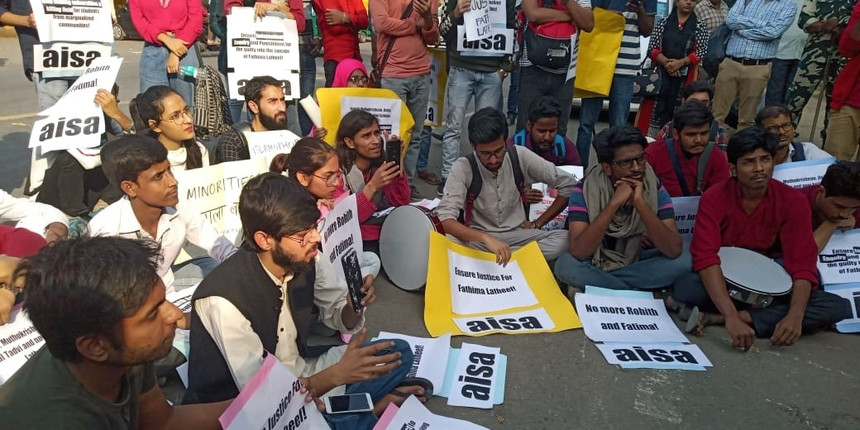
Student protest demanding enquiry into the suicides (Credit: AISA)Team Careers360 | Dec 3, 2019 - 5:40 p.m. IST
Share Via

NEW DELHI: The Indian Institutes of Technology (IITs) have seen 50 suicides in five years, the human resource development minister told Lok Sabha on December 2. The suicides took place at 12 of 23 IITs.

With 14 deaths in the last 5 years, IIT Guwahati had the maximum number of student suicides, followed by IIT Bombay and IIT Madras, which saw seven suicides each.

The ongoing investigations into the suicide of an IIT Madras humanity student, Fathima Lateef, and the death of an IIT Delhi student who jumped off a seven-storey building have brought the frequency of deaths at IITs into focus.

According to reports, there were four student suicides at the IITs in October and November.


Systems in place’

“Systems are in place in IITs to enquire and take action in all complaints from students in IIT campuses, which includes Student Grievance Cell, Disciplinary Action Committee, Counselling Centres, etc.,” said Pokhriyal.

However, the efficacy of these “systems” are under a scanner as they have been operational for the past five years when the number of suicides increased across the campuses.

Meanwhile, the minister also informed that Indian Institutes of Management (IIMs) saw 10 suicides across eight campuses in the last 5 years.

For help, AASRA has a list of resources here: http://www.aasra.info/helpline.html

Write to us at news@careers360.com.

High court reserves order on PIL for CBI probe into 14 suicides on IIT Madras Campus _ TNN

After Scrutiny Over Suicides, IIT Madras Faces Probe By SC/ST Commission - NDTV


After Scrutiny Over Suicides, IIT Madras Faces Probe By SC/ST Commission

IIT Madras made the headlines last month after a first year student of its integrated MA program, was found dead in her hostel room - the fifth case of suicide reported in the past 11 months
Reported by J Sam Daniel Stalin
Updated: December 04, 2019 10:19 IST

A first year IIT Madras student was found dead in her hostel room last month

IIT Madras, one of the country's premier educational institutions, is facing allegations of discrimination against students and faculty from Dalit communities. Among the concerns and complaints raised are the lack of reservation and promotion in jobs, as well as allegations of mental harassment and abuse leading to student and faculty suicides, and the lack of a liaison officer to coordinate between employees and students from Dalit communities and the IIT Madras administration.

Concerns have also been raised over barriers to admittance; over the last decade 2,320 students were admitted to the Master of Science (MS) program but only 47 were from Scheduled Castes and only 6 were from Scheduled Tribes. 

In the same period nearly 4,000 PhDs were awarded, but only 213 went to students from Scheduled Castes and 21 to those from Scheduled Tribes.

Swaraj Vidwaan, member of the national commission on SC/ST who visited the campus recently, has confirmed a probe will be launched. The commission, which has released a statement on the situation, has indicated it will also inform Prime Minister Narendra Modi and President Ram Nath Kovind.

"This has been going on forever... as far as faculty is concerned, basically IIT never advertises. Only online applications... and even though there are not many qualified candidates from Dalit communities, those that apply are rejected even if they have degrees from abroad," Dr E Muralidharan, an IIT Madras alumnus, told NDTV.

"The Madras High Court has said all applications must be interviewed... it is the law... but still these jobs go to upper caste candidates. 88 per cent of jobs go to them even though they are not supposed to cross 50 per cent limit," he added.

Professor Bhaskar Ramamurthi, IIT-Madras Director, claims there is a shortage of qualified candidates from Scheduled Caste and/or Tribes. The institution, however, is addressing this sensitive issue.

"We are alert to this... the Government of India has a clear policy and we want to be compliant. It is a challenge... the number of eligible candidates for faculty is less, but the situation is changing. Also, PhD enrolment by candidates is increasing... 300 reserved category scholars enrolled for PhD this year," he told NDTV in July.

IIT Madras made the headlines last month after a first year student of its integrated MA program, was found dead in her hostel room. The family of the student, a young Muslim woman, had alleged discrimination and claimed she had named three faculty members in an alleged suicide note left on her mobile phone.

That was the fifth case of suicide reported from IIT Madras in the past 11 months; four were students and one was a woman faculty member.

Wednesday, December 4, 2019

Suicide Note Recovered from IIT-Madras Student's Mobile Phone Authentic, Say Police - News 18


Suicide Note Recovered from IIT-Madras Student's Mobile Phone Authentic, Say Police

IIT-Madras student Fathima had committed suicide last month allegedly after harassment by faculty members.

Poornima Murali | CNN-News18Updated:December 4, 2019, 10:35 AM IST

Chennai: Over 20 days since Fathima Lateef, an IIT-Madras student, committed suicide inside her hostel room, police sources said that the alleged suicide note recovered from her mobile phone is authentic. In the note, Fathima had blamed a faculty member for compelling her to take the extreme step.

The note, dated November 8, was discovered by Fathima’s sister Aysha when she had switched it on a day after her death. She then went to the police station and the phone was then sent to cybercrime department to examine the credibility of the note. Aysha had told the police that the note was her mobile phone’s screensaver.

She had told the police that the phone was untouched till she approached the police station a day after her death.

Fathima’s family had submitted her laptop to the Central Crime Branch on November 27 and has been sent for forensic examination.

Meanwhile, the three professors of IIT-Madras were questioned by the Central Crime Branch for three days inside the campus after the case was transferred to the special team.

Fathima, a humanities student, killed herself on November 9 at the Sarayu hostel inside IIT-Madras campus. The case came to limelight after her parents sought a thorough investigation and blamed faculty members at the campus for her death.

The suicide sparked an intense debate over whether IIT-Madras needs to take more measures to ensure students are not subjected to performance pressures, or those of other kinds.

Two petitions have been filed so far before the Madras High Court demanding a CBI probe in Fathima's death and the number of suicides across IITs. The Madras High Court while hearing one of the petitions today observed that a probe is still underway and has reserved its order.

50 Student Suicides In 23 IITs In 5 Years: Govt BW Education


50 Student Suicides In 23 IITs In 5 Years: Govt

HRD Minister Ramesh Pokhriyal provided the data in a written reply to a question asked by Revolutionary Socialist Party MP N K Premachandran on Monday.


The 23 Indian Institutes of Technology (IITs) have collectively witnessed 50 student suicides in the last five years, of which 14 have taken place in IIT-Guwahati alone.

HRD Minister Ramesh Pokhriyal provided this data in a written reply to a question asked by Revolutionary Socialist Party MP N K Premachandran on Monday. The information is significant in the backdrop of the recent suicide of a student named Fatima Latheef at IIT-Madras.

In the reply, Pokhriyal acknowledged that the ministry had received several representations from MPs seeking a probe into Latheef’s suicide.

“IIT Madras has informed that immediately after the incident was reported to the hostel authorities, the police were informed. The police on arrival took over the custody of the hostel room along with the materials inside and started investigations. Subsequently, the case has been transferred to the Central Crime Branch of Tamil Nadu Police. IIT Madras administration is fully cooperating with the police, who are continuing with their investigations,” the reply states.

As per the data shared by the ministry, IIT-Madras and IIT-Bombay witnessed the second largest number of suicides in the last five years. Both had seven suicides each. IIT-Delhi had 4, IIT-Kharagpur 5, IIT-Kanpur witnessed one and IIT-Roorkee two.

The suicide numbers for the IIMs were relatively better. The 20 IIMs collectively witnessed 10 student suicides in the last five years.

(Source: IndianExpress Education)

Tuesday, December 3, 2019

Fathima Lateef - Times Now India

Why This IIT MADRAS Student Fathima Latheef Committed Suicide? - A P Herald


INDIAHERALD.COM
POLITICS

By SIBY HERALD , 17 days ago,


Reportedly Manitheneya Makkal Katchi (MMK) leader M.H. Jawahirullah on wednesday demanded a probe by Crime Branch Crime Investigation Department (CBCID) into the suicide of Fathima Latheef, a bright first year student of the indian Institute of technology madras (IIT-M). Meanwhile Fathima, a first year masters student in Humanities and Development Studies in IITM, was found hanging from the ceiling fan in her hostel room on november 9.


As per report no suicide note was found, a note on her mobile phone had mentioned some faculty names as the cause of her death. Furthermore in a statement issued here, Jawahirullah said that he had spoken to Abdul Latheef, the girl's father, who alleged that his daughter was subjected to religious discrimination by a faculty member. Perhaps according to Jawahirullah, Fathima's father had told him that once the professor had given his daughter three marks less and the same was corrected after it was brought to the notice of the head of the department.

Jawahirullah told "The girl's father had told me that there was religious discrimination". Meanwhile hailing from kollam in kerala, Fathima was a bright student and her father has given a memorandum to kerala chief minister pinarayi vijayan, requesting kerala government's intervention in the probe into his daughter's death. Apparently Fathima's case is the fifth suicide at IIT-M in the last one year.

Sunday, December 1, 2019

NCSC tells IIT-M to submit report on the number of SC/ST suicides - Nidian Express

NCSC tells IIT-M to submit report on the number of SC/ST suicides

She was talking to newspersons on the sidelines of Coordination Committee meeting of Federation of All IITs SC/ST Employees Associations.

Published: 30th November 2019 06:34 AM | Last Updated: 30th November 2019 06:34 AM | A+A A-
By Express News Service

CHENNAI: National Commission for Scheduled Castes (NCSC) Member, Swaraj Vidwaan, on Friday pulled up the Indian Institute of Technology- Madras for not recognising SC/ST Employees Welfare Association and asked the institute to submit a report on how many students among those who had killed themselves on the campus, belonged to SC/ST communities. 

She was talking to newspersons on the sidelines of Coordination Committee meeting of Federation of All IITs SC/ST Employees Associations.

“The institute does not have a SC/ST grievance redressal cell. Where would students and professors register their grievances? It should be formed immediately,” she said adding that the students, especially those belonging to SC/ST communities, face mental harassment in the institute. On the institute’s alleged failure to follow reservation, she said of the 2,320 students admitted to MS programme in the last 10 years, only 47 were from the Scheduled Caste community and six from Scheduled Tribe. Of the 3,846 admitted for PhD in the last 10 years, only 213 and 21 were from SC/ST.

A Commission staff told Express that the institute did not furnish data on the number of SC/ST students who killed themselves between 2006 and 2019. He said the institute would be issued with a formal notice. “Complaints were received from students that management refused to discuss increasing suicide cases and did not help readily.”

Plea in Madras HC for CBI Probe into 14 Suicides in IIT Madras, Blames 'Discrimination' over Religion, Caste, Language - News 18


Plea in Madras HC for CBI Probe into 14 Suicides in IIT Madras, Blames 'Discrimination' over Religion, Caste, Language


Loktantrik Janata Dal said 14 students have so far reportedly committed suicide on the IIT Madras campus since 2006 as they faced "discrimination" on the basis of religion, caste and language.


PTIUpdated:November 29, 2019, 11:02 PM IST

Chennai: The Loktantrik Janata Dal's youth wing has moved the Madras High Court, seeking a CBI probe into '14 suicides' at the IIT-Madras here since 2006.

The outfit, in a Public Interest Litigation petition, said 14 students have so far reportedly committed suicide on the IIT Madras campus here since 2006 as they faced "discrimination" on the basis of religion, caste and
language.

Of the students who ended their lives, five were from Andhra Pradesh, three from Kerala, two each from Tamil Nadu, and Uttar Pradesh and one each from Puducherry and Jharkhand and recently Fathima Latheef, a 19-year old student had committed suicide.

However, the institution has not taken any steps to go into the reason behind such suicides, national president of the party's Yuva Janata Dal, Saleem Madavoor, said. Neither the Tamil Nadu government nor the local police had conducted any fruitful inquiry to bring out the reasons behind such deaths, he alleged. The PIL plea is expected to come up for hearing on December 2.

Why Are Students Angry? Is Conflict Over Public-Funded Higher Education Only Reason? - Outlook India


Why Are Students Angry? Is Conflict Over Public-Funded Higher Education Only Reason?

Fee hike during times of privatisation coupled with debates over ideology, caste-exclusionary elitism and gender equality are among the main reasons why university students are up in arms

SALIK AHMAD28 NOVEMBER 2019

Facebook Twitter Google + Linkedin Whatsapp Comments


THE OPPOSITION
Students of JNU, Delhi, protest against fee hike and draft hostel manual
PHOTOGRAPH BY GETTY IMAGES

Also Read
OPINION | The Death Of Student Power And How Governments Played Their Part
BJP Govt Constantly Attacking Universities: AMU Students Union Honorary Secretary
Education Not A Commodity, It's A Public Good: Shehla Rashid
JNU Fee Hike Issue A Façade, There Were Ulterior Motives To Students' Protest: ABVP Delhi Secretary
We Are Fighting To Save Last Bits Of JNU’s Essence: JNUSU President Aishe Ghosh
OPINION | It'll Be A Shame If People From Disadvantaged Sections Can't Study At JNU
OPINION | Death Of JNU Will Mean Destroying A Good Liberal University
There Can’t Be Saffron, Green, White Or Blue-Coloured Education: Murli Manohar Joshi
Lessons For The Elite

They are a bunch of vandals. They are the spring itself. They are freeloaders and parasites. They are the gene map of the future, of possible futures. They are an unruly, seditious mob. No, they really are the ones who bring life to democracy, the ones in whom freedom breathes its purest air.... Students! It’s often with a note of exasperation or scorn—one that hides a deep suspicion, even dread—that the world outside looks at university campuses. For all the belittling, nothing outside of war and religious/cultural animus seems to bring about such stark binaries of opinion as the image of protesting students. Why? Each day now brings profoundly troubling news. Something or the other is in deep crisis—the Constitution, political morality, entire sectors of the economy, the climate, and all of them at once. But if you looked at mainstream or ­social media, it would appear as if the biggest question in front of the nation is a bunch of students protesting. Why? Because it is war. Of another sort. The image of angry, dissenting students has come like a regular punctuation mark, an irritating comma, in recent years. That too in a field of seeming unanimity ­otherwise, whether in terms of electoral politics or mainstream headlines. It happened first on the FTII campus in Pune, then the Rohith Vemula sui­cide capped an extraordinary season of defiance in Hyderabad. It takes JNU, however, to get the citizenry really upset. The question everyone asks is: why are the students angry? Almost, how dare they protest? And, shouldn’t they be studying and getting a job instead?


No one in India asked these ­questions when tanks rolled into Tiananmen Square in 1989, after ­student-led protests brought million-­strong crowds into that iconic venue in central Beijing, defying China’s ­authoritarian one-party rule and seeking various freedoms. No one asked this when American students protested against the Vietnam War five decades ago, forcing the Nixon ­administration to blink. Or when the Soweto uprising by Black students in 1976 set in motion a chain of events that turned history’s page on the world’s last legally racist regime. Or when students without count became the lifeblood of India’s freedom movement—joining Gandhi, or sundry revolutionary movements, filling up jails. It’s only the ruling elite in each instance that asked the question. It’s only after freedom that dissenting students again became a troubling bogey, with the Naxalite movement. Or Assam. Or the protests against Indira Gandhi’s authoritarianism. A whole galaxy of mainstream politicians—from the recently dec­eased Arun Jaitley to the jailed Laloo Prasad Yadav to Nitish Kumar and Union minister Ravi Shankar Prasad—found their life’s calling as protesting ­students before or around the Emergency. In world history or in India’s, student politics has been so deeply constitutive of politics that the question “why” can only come from those utterly innocent of history.


SCRIPTING THE CHANGE

Protests in Jadavpur University.
But history finds its linkages. The powerful #FeesMustFall protest led by university student Shaeera Kalla rocked South Africa in 2015, forcing a rollback of fee hikes. For the past few days, Kalla has been tweeting in solidarity with protests by JNU students in Delhi. The immediate cause is a doubling of hostel and mess fees, to about Rs 60,000 a year—India’s annual per capita income is around Rs 1.26 lakh. (As of this week, they have rejected the offer of a 50 per cent concession in the hike.) The issue of fees, however, is embedded in a deep disquiet over the new policy approach to public-funded education. News came half-way through the JNU protests—in between marches, placards, lathicharges and shows of solidarity on other campuses—that even ­institutes like AIIMS, India’s premier medical school, would see fees going from Rs 6,000 to Rs 70,000.


The quality of output of AIIMS was never in doubt. JNU produced a recent Nobelist in Abhijit Banerjee; two of its alumni­—Nirmala Sitharaman and S. Jaishankar­—are in the Union cabinet. It could be easily argued that India needs to extend the existing model, not ­dismantle it. Clearly, there is a crisis. Students and academics call it ­commodification of education. The proposed fee hike will make JNU unafford­able for a substantial percentage of its students: an exclusion that will lead to erosion of diversity (see May the Nation Meet the Varsity, p.40). A JNU alumnus walking in a protest march says ­education must be free and accessible to all. Says Jitendra Kumar, now pursuing PhD in Persian from Delhi University, “JNU had fiercely protec­ted its accessibility, and ensured it rem­ained within reach of the poorest. Now, they are attacking even that one beautiful university.” This spirit chimes across campuses. Rohith Vemula’s suicide had come seven months after the University of Hyderabad stopped the Dalit research scholar’s monthly stipend of Rs 25,000. In his memorable suicide note, he made a request that the accumulated amount be paid to his family.


Protests in University of Hyderabad.
PHOTOGRAPH BY PTI

Fee hikes are the face of creeping privatisation, and the State’s wish to retreat from public funding of higher education, framed within the draft New Education Policy. But they are not the only reason why ferment arises. There are debates over ideology, caste-exclusionary elitism and gender inequity. It was in left-liberal spaces such as JNU and Jadavpur University in Calcutta that the #MeToo storm broke out. The 2015 protest at FTII, alma mater of some of India’s finest cinema figures, was occasioned by B-movie actor Gajendra Chouhan’s appointment as chairman­—“not people one would want to learn from,” as FTII alumna Ashmita Guha Niogi put it. A four-month protest was sparked off in 2014 at Jadavpur by the molestation of a female student. In 2017, ref­usal by BHU authorities to act on a ­f­emale student’s complaint of eve-teasing led to protests that hogged TV news for days. Earlier this month, IIT Madras swam into headlines after the suicide of Fathima Latheef, a hum­anities student.

On the surface, these seem disparate themes. But girding them together are underlying themes rev­olving around various forms of freedom, or its lack. Akanksha, an MA (political science) student at BHU, exp­lains why they protested, even facing lathicharges, after the molestation case: “The guards of the proctorial board started asking the victim why she was outside the hostel after 6 pm.” Akanksha says it was a landmark in the university’s history and the girls celebrate their unity on the day every year. “We also took out a march in support of Dr Fir­oze Khan,” she says. Khan’s appo­int­ment in BHU’s Sanskrit department was met with opposition from a section of the university community due to his religious identity. Fathima Latheef’s parents, similarly, said harassment by Hindu professors due to her religion compelled her to end her life. The demand for professors apparently named in her suicide note to be arrested has not died out yet. Religion had popped up last year too, as a major protest at AMU provided fodder for a polarising national debate. The stud­ents union hall had a Jinnah portr­ait—put up in 1938 when he was conferred a life membership of the union—and the local BJP MP wanted it removed. ‘Protesters’ entered the campus, provocative slogans and clashes ensued, followed by the familiar sequence of more protests and lathicharges.


Protests in FTII, Pune.
PHOTOGRAPH BY AP

Suicides due to institutional causes lend a morbid edge to the debates. It’s an act of moral defiance that the system finds difficult to counter. One such was the case of S. Anitha, a Tamil-medium state board student who committed suicide after failing the centralised NEET exam in 2017. A district topper with cent per cent marks in physics and math, the Dalit dailywager’s daughter had earlier implea­ded herself in the Supreme Court case against NEET. The snowballing protests framed a different kind of inequity. Yet, the courts have frequently expressed society’s doubts about ‘student protests’. Even in neighbouring Kerala, a hotbed of student activism, a 2017 high court order explicitly endo­rsed the right to rusticate and banned prote­sts on campus, arguing that such practices had “no place in a constitutional democracy—much less in academic institutions”. The uproar was near-­unanimous­—if students were muzzled, it would leave exploitative and chauvinistic practices by institutions unchecked, said students.

The criminalisation of student protests saw a farcical peak at Panjab University, Chandigarh, after a fee hike in 2017. An alleged attempt by protesters to force their way into the VC’s office led not just to a lathicharge, but also ­sedition charges against 66 students! “The charges were dropped later, but the students still have to go to court every month for other cases,” says students council president Kanu­priya Devgan. “Their careers are at stake. For what? Fighting for your rights? Is education a commodity like onions that it should get expensive?”


Student protesters in Hong Kong.
PHOTOGRAPH BY GETTY IMAGES

The squeezing of public resources comes against a scenario of scarcity. The biggest issue at the Chandigarh campus is of hostels. “I’ve seen students crying for hostels. They can’t afford the new hostels built on the public-private partenership model,” says Kanupriya.

Nandita Narain, associate professor of mathematics at St Stephen’s College, Delhi, and former president of the Delhi University Teachers Association, says the State’s retreat began in the wake of globalisation when education started being seen not as a right, but a luxury—those who want it must pay for it (see It’s the Birla-Ambani Plan, p.50). From 4.14 per cent of the GDP half a decade ago, the ­Cen­tre’s budget ­allocation to ­edu­cation has come down to 3.4 per cent for 2019-20.


HERITAGE OF THE YOUNG


Anti-war students shot in Kent University, USA, 1970.
In terms of its proportion to the total budget, the decline looks minor. But just look at the ­immensity of the ­challenge India faces in preparing for the future, and then at how paltry both those figures are. “Lack of sufficient public funding over decades is largely responsible for this sad state of affairs,” says development ­economist A.K. Shiva Kumar. “Concerns of ­equity, ­affordability and quality have to be ­addressed. The increasing trend towards privatisation is worrying. State-funded universities have played a major role in ­extending access to ­quality higher education in most developed ­countries. We forget that a majority of senior professionals in India too have been ­beneficiaries of a heavily ­state-subsidised education.”

Is there a counter-view? “I am not ­saying don’t subsidise,” says IIT Ropar ­director Sarit K. Das. “But whom should we subsidise? Flat general subsidy never works. Let it go to people who deserve it. There are two ways. Demarcate student fees according to socio-economic status, or directly transfer money to those below the poverty line.” A line that has been taken across the board with human development policies—and, as many ­development experts would say, not with much success.
***
Vox Pop
Ambika Subhash MA in economics, JNU

At NIT Calicut, we faced such high academic pressure that two students committed ­suicide every semester. The ­attitude of ­teachers worsened it. Say, if a ­reserved category students got low marks, they would be told to find another college. I have faced that myself. Students at IITs/NITs face a lot of trauma, but are ­unable to speak: they are afraid of losing a Rs 20 lakh package. I just feel so free, so happy in JNU. The fee at NIT was raised from Rs 10,000 to Rs 1.2 lakh per semester over the past six years. Of 6,000 students, only 60 came out in protest. And they were targeted viciously by the administration.
Vishwas KukretiPhD in econophysics, JNU, ABVP member
Freedom of expression is like a string instrument. If you loosen or tighten the strings too much, you can’t play. It’s only when the tension in strings is optimal that a fine sound is produced.

Syed Wajahat AliBA in political science, JMI
Only god or devil can be ­apolitical. I wasn’t given a ­hostel seat as I participated in a protest demanding a ­students union. Living outside costs me about Rs 10,000 a month. My ­father retired five years ago and this expenditure is not easy for him to manage every month.

Sayantani Banerjee PhD in linguistics, IIT Delhi
If a chief minister can buy a ­private jet with taxpayers’ money, why can’t it be spent on the education of students?

Biswarup BaidyaDepartment of international relations, Jadavpur University

Many students coming here are the first generation in the family to get an education. Does the government even know what the fellowship money means to them? Is the government ­making fun of them? Even if they don’t get a fellowship, the low hostel fee plays an ­important role in their survival.

Brig (retd) G.B. ReddiPolitical commentator, Hyderabad
The root cause of proliferating student protests in India is ­excessive politicisation of ­academic institutions. Instead of promoting unity, ­ethics, ­values and discipline among students, and improving the quality of education, ­academics in India today are mostly sowing the seeds of divisiveness based on their left- or right-wing ­ideological orientation.

Ranjini BasuPhD, Development Studies, TISS, Mumbai
We need diversity in ­classrooms, among teachers and in the choice of courses. If you are surrounded by your own kind of people, you’ll remain ­ignorant of so many realities.

Hamza TariqPresident of NLSIU Student Bar Association, Bangalore
We were also against a fee hike, but nothing came out of the protests. We are still ­planning to approach the courts. The hike is quite ­substantial—for example, I paid Rs 1.8 lakh in fees last year and now it’s Rs 2.35 lakh. I think universities should pursue other ways to get money. Allocation to education as a percentage of the GDP has only decreased since 2014.

Sitaram YechuryCPI(M)
“The struggle in JNU is part of a larger struggle to protect ­public-funded education ­institutions from government ­interference. These attacks on higher education are a result of the Centre’s quest to make ­education a privilege. This scheme fits into their ideological construct, where in order to ­establish a Hindutva Rashtra, they have mounted an assault on reason and replaced rationality with irrationality. This agenda is very dangerous for the future of India. JNU is a bastion of learning and needs to be protected from the designs of the government.”

Situation in IIT Madras grave when it comes to SC/ST students and faculty, says NCSC member Swaraj Vidwaan - The Hindu


Situation in IIT Madras grave when it comes to SC/ST students and faculty, says NCSC member Swaraj Vidwaan

Pon Vasanth B.A
CHENNAI, NOVEMBER 29, 2019 14:25 IST


A view of the entrance of IIT Madras | Photo Credit: M. SRINATH

The National Commission for Scheduled Castes Member said employees from SC, ST and even OBC communities faced discrimination and mental harassment at the institution

National Commission for Scheduled Castes (NCSC) Member, Swaraj Vidwaan, on Friday said that the situation in IIT-Madras was grave and deeply concerning when it came to students and faculty belonging to Scheduled Castes, (SC) and Scheduled Tribes (ST) communities.

Addressing media in the backdrop of the Coordination Committee meeting of the Federation of All IITs SC ST Employees Associations, for which she is the patron, Ms. Swaraj said that the reservation policy was not followed properly in faculty appointments and students admissions at IIT-Madras.

Ms. Swaraj said she had learnt from data collected by students and faculty members that of the 2,320 admissions made to M.S. programme in the last ten years, only 47 were from SC and six from ST communities. Similarly, she said that of the 3,846 Ph. D admissions in the last 10 years, only 213 were from SC and 21 from ST. “This is alarming,” she said.

The situation was the same when it came to the appointments and promotions of faculty members. “Reservation policy is not followed at all in engaging employees through outsourcing,” she said. She also said it was unjustifiable that the IIT-M administration has not recognised the SC ST Employees Welfare Association.

“Also, some of these issues could have been addressed if the SC ST Liaison Officer was discharging his duty properly. We hear that is not the case. The present officer must be changed,” she said.

Ms. Swaraj stressed the need to immediately form a functioning SC ST grievance redressal cell. She said that employees from SC, ST and even OBC communities faced discrimination, mental harassment, and lived in constant fear of receiving memos or other punitive action if they raised any issues.

Pointing out that she had visited at least three IITs before, Ms. Swaraj said the situation here seemed to be the worst. “The administration is functioning like a dictatorship,” she said, adding that all the students, including those from general communities faced numerous issues.

Highlighting that around 15 students have committed suicide in the last decade including the recent death of Fathima Latheef, she said the administration does not seem to have gone deep into the causes of these deaths and taken measures to prevent them. “I have sought details of how many of these students were from SC ST or OBC communities,” she said.

Stating that she had met the Director of IIT-Madras during this visit before all these issues were brought to her notice, she said she will issue a notice to the Director regarding all these issues. “I will also personally take it up with the President of India, Prime Minister, and the Minister for Human Resources Development since the issues are serious,” she said.

PIL in high court seeks CBI probe into 14 suicides reported in IIT-Madras since 2006 - Times of India